


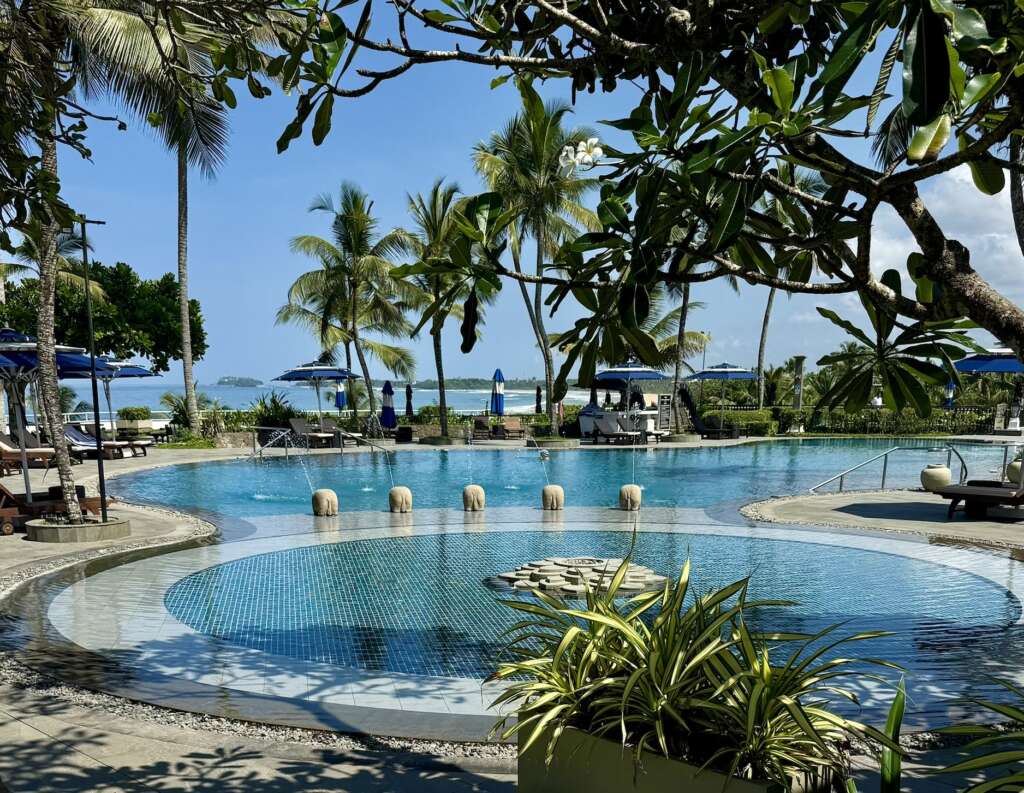
Perched proudly on a rocky headland, Taj Bentota Resort & Spa lets you step straight onto the sand for a quiet early-morning stroll along a stretch of coast affectionately nicknamed the Golden Mile. Roughly 60 kilometres south of Colombo – an easy, picturesque drive down the south-west coast – this sanctuary works its magic the moment you arrive. The warmth and attentiveness of the staff set a gentle, unhurried rhythm for the entire stay.
Early one morning, after yoga as the day was just beginning to break, I sat down to breakfast on the sand, fresh coffee in hand, watching the light slowly wake up the Indian Ocean. The wide, crescent-shaped shore glowed amber as the low sun struck the waves, and towering coconut palms cast long shadows across the damp sand. Unlike the smaller, rocky coves further south, this is a grand, uninterrupted sweep of coast – a broad ribbon of soft sand wedged between rustling palm fronds and the rhythm of crashing waves.

Architectural Heritage & Coastal Sanctuary
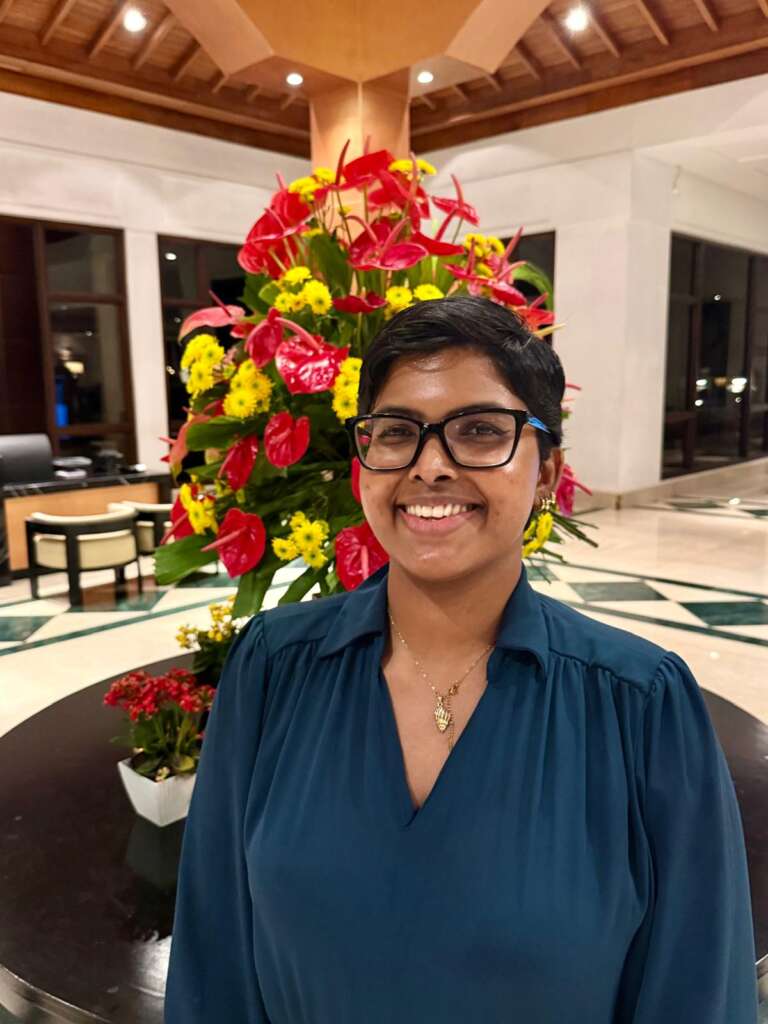
Built in the 1970s, the resort carries an unmistakable architectural prestige. Step inside and you’re greeted by a soaring foyer and an enormous tropical flower arrangement brimming with vibrant red heart-shaped anthuriums and bright yellow chrysanthemums set against lush green foliage. Beyond it, the restaurants and bar capture sweeping ocean views and cool sea breezes. At the heart of the property, an open-air central courtyard blends mid-century Sri Lankan tropical design with lush gardens and water features.
From its elevated headland midway between Colombo and Galle Fort, Taj Bentota is a serene base for exploring Sri Lanka’s south-western edge. The clifftop gardens take in panoramic views of the entire coastline, and you’re only steps from the quiet estuary where the Bentara River – also known as the Bentota Ganga – meets the sea after flowing 64 kilometres from the southern hills.
The setting has serious design pedigree. Bentota became Sri Lanka’s first national holiday resort in the late 1960s, when legendary architect Geoffrey Bawa designed the landmark Bentota Beach Hotel (now Cinnamon Bentota Beach). “He didn’t want you to hide out in your hotel all day on a sun lounger; he engineered the town to be a place you explored,” says Juliet Coombe, who calls Galle home.
“The Taj loved the open sea vistas,” Juliet says. “Geoffrey Bawa hid them along the main Bentota Beach stretch, shrouding a visitor’s arrival in mystery, but the Taj celebrates them from every angle.”
Flavours and Restoration at Taj Bentota
The experience goes well beyond the architecture. One afternoon, I joined a hands-on cooking class with the resort’s head chef, Piyush Mishra and his team. He describes his journey as going from his mum’s kitchen helper to a professional chef who tries to give character and emotion to food. Surrounded by aromatic piles of fresh curry leaves, toasted mustard seeds, cinnamon bark and freshly grated coconut, the chef guided me through the delicate art of Sri Lankan spice tempering. Together, we turned fresh local seafood and vegetables into vibrant, fragrant curries – a masterclass in balancing fiery heat with sweet coconut milk.
The sensory immersion continued at the spa, where I surrendered to an incredible two-hour massage. Rooted in traditional wellness practices, it combined long, rhythmic strokes with warm botanical oils, melting away every trace of travel fatigue and leaving me thoroughly restored for the adventures ahead.
The Taj believes wellness is also about indulging your body with massages and treatments to the sound of the sea. Equally, its approach is to combine pampering you in style with diving into centuries of extraordinary history – from the ancient ritual of mask-making to exploring Bentota town and the nearby UNESCO World Heritage site of Galle Fort with an insider who brings the living old quarter to life.
For me, the experience organised by the hotel was with Juliet Coombe, an author and award-winning photojournalist, whom has since become Women Love Travel’s Asia Editor.
Into the Mangrove Mazes: The Madu River Safari
Leaving the open coast behind, a short drive from Taj Bentota brings you to Balapitiya, gateway to the Madu Ganga wetland. Aboard a small motorboat, the roar of the ocean quickly gives way to the quiet lull of emerald waters weaving through dense, tangled mangrove forest – home to crocodiles, monkeys, and exotic birds.
Gliding beneath natural green tunnels where roots dip into the brackish lagoon, the river feels like a secret world of its own. Kingfishers flash vivid blue against the canopy, monitor lizards bask in the sun (see below) and cormorants sun themselves on low-hanging branches. The safari winds past tiny islands scattered across the estuary. On Cinnamon Island, we got a close-up look at traditional peelers stripping fresh bark by hand to yield Sri Lanka’s prized pure Ceylon cinnamon, its sweet, warm spice filling the humid jungle air.
Turtle Conservation at Kosgoda
Heading back up the coast towards Bentota, we stopped at Kosgoda, home to the Kosgoda Sea Turtle Conservation Project, one of the longest-running hatcheries of its kind in Sri Lanka. Founded in 1988 by Dudley Perera and still run by his family, it was set up to fight the drastic decline in sea turtle numbers caused by egg poaching, habitat loss and accidental entanglement in fishing nets.
Five of the world’s seven sea turtle species – green, hawksbill, olive ridley, loggerhead and leatherback – have been recorded along this stretch of shore. The team works closely with local villagers, buying eggs gathered on the beach that might otherwise be sold for food. That gives locals an eco-friendly income, and the eggs are safely reburied in protected sand hatcheries.
Visiting the hatchery offers a close-up look at this work. Alongside the incubation beds, the team rehabilitates injured turtles rescued from fishing gear. The most moving moment came at dusk, when I carefully cradled a newly hatched turtle, small enough to sit in the palm of my hand, and watched it make its very first scramble into the rolling surf of the Indian Ocean.
Unlocking Galle Fort with Juliet Coombe
Around 55 kilometres further south lies Galle, a delightful, action-packed day trip from Taj Bentota. The historic Dutch fort is fascinating on its own. Exploring it with Juliet turned a simple walk into an intimate journey behind its thick 17th-century ramparts.
Juliet’s connection to Sri Lanka runs deep. London-born, with an unmistakable West Country accent, she first arrived as a fearless journalist covering the civil war. Then her life took a dramatic turn when she fell in love with her translator. They married, raised two sons who now call Galle home, and put down roots in the fort’s vibrant, close-knit community. It was this welcoming atmosphere, where generations of Muslim, Burgher, Sinhalese and expat families live side by side, that ultimately won her over.
The Walls That Withstood the Tsunami
As we walked the ancient stone ramparts, conversation turned naturally to the defining moment of the 2004 Boxing Day tsunami. Locals quietly shared harrowing memories of that morning. The surrounding coastline suffered catastrophic devastation and immense loss of life. But the fort’s massive Dutch stone walls and the protective offshore coral reef acted as a shield, absorbing the worst of the wave’s deadly force and saving those sheltered inside. Outside the walls, many were not so fortunate, and listening to the stories of those who lived through it was deeply moving.
One of them was young English hotelier Ivo Richli, who was just 10 years old when the tsunami struck. The fort walls saved his life, he told us – he owes that life to Galle, and it’s where he’ll spend the rest of it. True to his word, Ivo is now group general manager of The Charleston, a 1924 art deco residence at the southern tip of the fort. It was restored over three years and reborn in 2024 as a nine-bedroom boutique hotel. On the top floor, Charlie’s Bar & Bistro has a pool terrace that gazes over the old town’s rooftops to the Indian Ocean. The bar is named after Charles Hulse, a much-loved local who made the fort his home in 1974.
Artisans, Gems and Hand-Painted Treasures
Moving on from Ivo’s story, we wandered deeper into cobblestone laneways lined with red-tiled roofs. Along the way, Juliet showed us a living, creative community – from local artists and craftsmen to the best places to eat – and told us the stories behind every one of them.
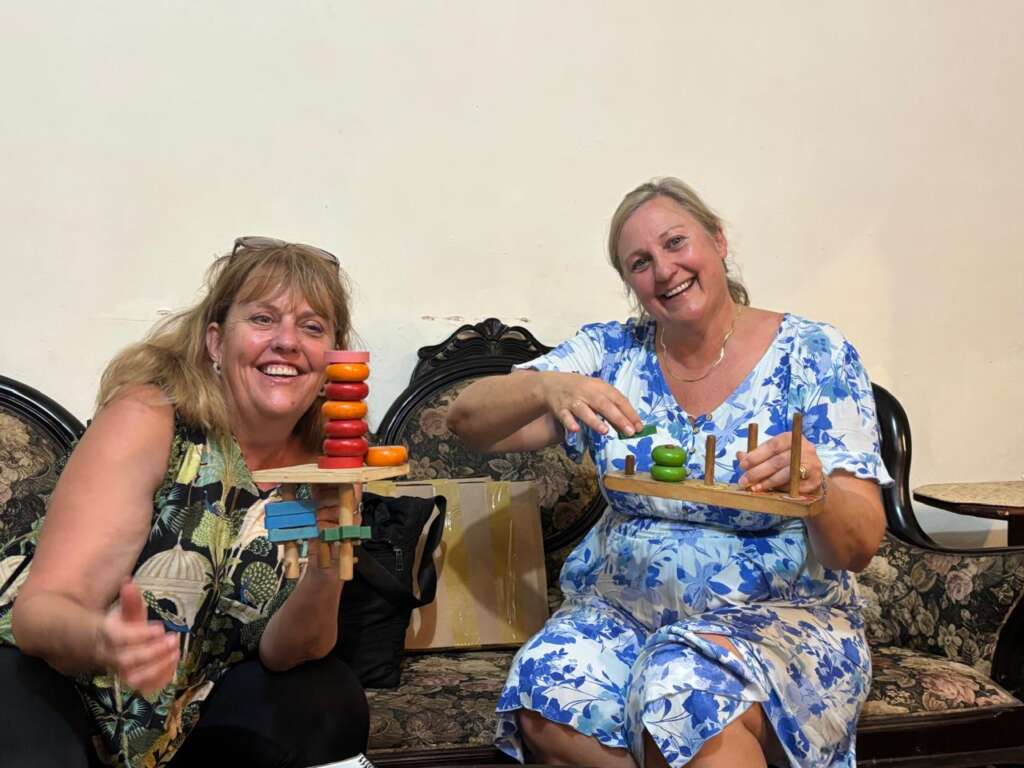
A short stroll away, Sithuvili Gallery is an artisan haven owned by award-winning artist Janaka De Silva, whose vibrant work captures the soul, colour and rhythm of Sri Lanka. We talked about his inspiration, from the ancient ritual of mask making to the intricate patterns of daily island life. Janaka is renowned for preserving traditional heritage. He specialises in handcrafted masks, restored antiques and wood panels made entirely from reclaimed timber and natural pigments.
Beyond its curated selection of hand-painted furniture, Jaffna antiques and upcycled crafts, the gallery runs hands-on mask-painting classes with Janaka and local artisans. It also offers international shipping with custom crating for travellers collecting larger pieces.
It would have been rude to walk away empty-handed. I left with two exquisite hand-painted plates – now treasured reminders of my trip – not to mention locally made dresses, a few trinkets and a pair of pink sapphire earrings.
Sweet Pauses & Colonial Elegance
Escaping the afternoon heat, we ducked into Café 82 on Church Street, a cosy ice-cream parlour run from the family’s ancestral home. The mother makes every scoop herself and runs the café with her son, Hiraz, and her daughter, who bakes the croissants. The ice cream is homemade, vegan and has no added sugar, and scoops of creamy coconut, Ceylon cinnamon and tropical fruit made the ultimate plant-based refreshment. Bring cash – it doesn’t take cards.
Later, the afternoon folded into evening over a relaxed dinner at AQUA Forte, set in a restored colonial building on Leyn Baan Street. Beneath high arched, shuttered windows, we shared a delicious lobster risotto and warm conversation with two of its co-founders, Roberto Vicario and Paolo Gavioli. After falling in love with this corner of the world, they swapped life in Italy and careers in engineering at 50 to become award-winning restaurateurs. Roberto heads the kitchen as executive chef, and the pair share the role of managing director. Their AQUA family has since grown across the fort to include AQUA Pazza and AQUA Forno.
Thanks to Juliet and the team at Taj Bentota, my day in Galle offered a rare, personal window into the lives and customs of local Sri Lankans.
The Soul of the Southern Coast
As night settled over Galle Fort, the gentle hum of the living ramparts echoed the quiet magic of south-western Sri Lanka. This stretch of coast offers far more than a typical tropical escape: the early-morning stillness of the Golden Mile at Taj Bentota, where yoga on the sand meets decades of architectural heritage and legendary hospitality; the emerald labyrinth of the Madu River and the hatchlings of Kosgoda; and the warm-hearted community within Galle’s stone walls. It is a place where nature, craftsmanship and human resilience intertwine.
For Juliet, that’s exactly the point. “Bawa reshaped Bentota in the 1960s and created a lasting travel philosophy: that a destination is meant to be actively discovered, ideally through its people – not just looked at and ticked off a bucket list,” she says. “Like Bawa himself, Taj Bentota frames your stay not only around wellness, but around unforgettable moments that are rewarding, raw and relentlessly real.”
In the Footsteps of the Bawa Brothers
My one regret? I didn’t even have time to visit the famous Bawa gardens, just a short drive from the hotel. Lunuganga, on the shores of Dedduwa Lake, was the country estate of Geoffrey Bawa, Sri Lanka’s most celebrated architect and the father of tropical modernism. Once a cinnamon and later a rubber plantation, it was bought by Bawa in the late 1940s. He spent the rest of his life shaping it into a series of terraces, outdoor “rooms” and framed views, a living laboratory for ideas that blurred the line between inside and out. His ashes rest there today.
Nearby, his older brother Bevis, a landscape architect, began creating Brief Garden in 1929 on the family’s rubber estate. It’s named for the successful legal brief that paid for the land, and its ornate gateposts were made with Australian artist Donald Friend. “The Bawa brothers were a fiery, extraordinary double act – often at odds with each other, but so radical and fun they drew global celebrities like Vivien Leigh and Laurence Olivier to their doorstep,” says Juliet. Together, the two gardens are a pilgrimage for design lovers – and one more reason to return.
Leaving Sri Lanka’s fragrant shores, it’s impossible not to feel touched by the deep sense of place held so gracefully by the people who call it home.
Robyn Foyster was a guest of Taj Bentota Resort & Spa.
