


Discover the mysterious Loris, the world’s oldest primate, and how it’s being rewilded in Sri Lanka so it can thrive again in Sri Lanka’s night forest ecosystem where it plays a vital role. Report by Juliet Coombe
Imagine a moonlit night in Sri Lanka’s dry forests. Everything is silent. Then, in the darkness, something suddenly moves. Two huge, round luminous amber eyes shine like glowing orange marbles that pierce through the canopy darkness.
Tiny limbering fingers give them a vice like grip, despite being as thin as matchsticks, they wrap them around a branch without making a sound after peeing all over themselves both hands and feet to stop the insects biting their bodies as they navigate their way through the bamboo forest. Travelling from one tree branch to the next in search of insects to eat. This is the Grey Slender Loris, the worlds oldest and smallest primate on Earth, and one of the most mysterious.
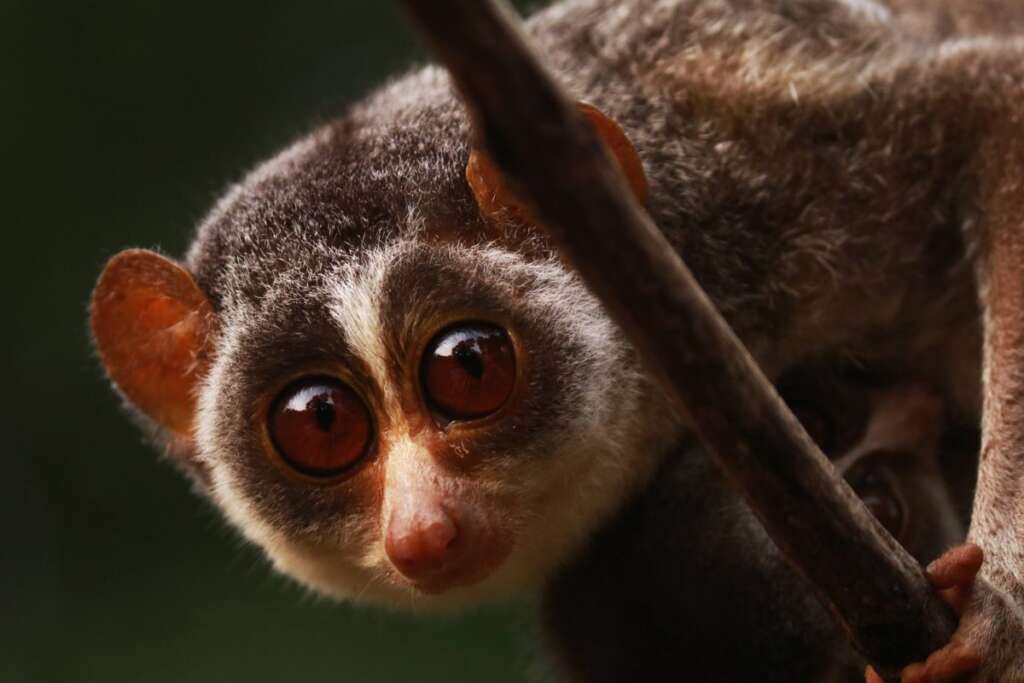
The Slender Grey Loris is pint size only about 8 inches long – smaller than a ruler with a toxin defence system, which is not as folklore has previously suggested poisonous to us. It has incredibly thin bandy arms and legs that look almost too delicate to be real. It moves in slow motion, like it’s swimming through the air. While other animals sleep, the Loris wakes up. It becomes a silent hunter of the night, catching insects that most animals never see, before vanishing back into the forest rolling into a tiny light grey ball as the sun starts to come up.
For thousands of years, Lorises have lived in these dense tropical forests, almost invisible to humans except for its shrill calls. It’s like a ghost, there but not there. Ancient, gentle, and perfectly designed for darkness, the Grey Slender Loris is one of nature’s best-kept secrets. Most people will never see one. But those who do, never forget its large red eyes looking back at us through the canopy.
The word “Loris” comes from an old word meaning “clown” due to its saucer like eyes or “strange humorous character.” People probably called it this because it looks unusual with it’s big eyes, thin body and slow to fast moving movements along the interconnecting branches of the forest.
In Sinhala, the Loris is called “Unahapuluwa.” This name is usually used to describe very thin people, so thin you can see their bones. It shows that people thought the Loris looked strange or even unhealthy.
Many villagers even today are suspicious of Lorises. Some believe they are bringers of bad luck if you see one. Others say the Loris makes a sound like a cobra snake, which scares people. There are old folk stories that claim they have magical powers, maybe they can curse you or bring evil spirits into your life.

The truth is the Loris whether Grey or Red is a very special animal to see and in reality just a small, gentle creature trying to survive in our fast changing world. It doesn’t have mystical powers. It doesn’t bring bad luck. It’s not dangerous. These superstitions exist because for hundreds of years, people never studied these beautiful forest dwellers. Education and awareness nature documentaries can change these beliefs over time and tourism can, done in the right way, help protect Lorises habitats long term.
Jetwing Vil Uyana, where the first and largest numbers of Grey Slender Lorises can be observed in the world with red torches, wasn’t built to fight against the natural world or to push it away. Instead, it was designed by environmental architect Sunela Jayewardene to be a sustainable, with huge water tanks dug to recreate a wetland habitat for us all to live together in harmony, side by side. The dwellings inspired by traditional farmers watch towers blend into the rice paddy fields, forest, garden and water tanks. Wooden boardwalks float gently above the ground, so animals can walk or swim underneath them freely like the increasingly rare Mugger Crocodiles, who have taken up residence right in front of the resort restaurant. When you stay here, you’re not just looking at nature through a window, you’re living inside it.
Chaminda Jayasekera, the naturalist who discovered the first Loris in the grounds of Jetwing Vil Uyana says, “I’m extremely proud of the Loris project. I was lucky enough to discover Slender Lorises in October 2010 and develop them into an eco-tourism product for the travel industry.” Now Jetwing Vil Uyana is famous as a “Loris Haven.” He did many awareness programs since this exciting discovery, created the Loris Conservation Fund, a centre with information boards, published a book about Slender Grey Lorises, which brought the world’s best wildlife film channels (BBC and National Geographic) to film there. Chaminda even got to give a presentation to primate conservation master’s students and academic staff at Oxford Brooke’s University in the UK. This shows that investing in wildlife protection isn’t just good for nature – it’s good for business and the naturalists who dedicate their lives to the wild.
Water and food are the two most important things for any animal. Before Jetwing Vil Uyana was built, this area near Sigiriya Rock Fortress was almost barren – dry land with very few trees. But through the visionary Chairman Hiran Cooray of Jetwing Symphony PLC they decided to rewild the environment planting native trees, creating new water sources and very quickly the area became rich with life again. When there’s plenty of water, plants grow and when plants appear, insects come. When insects are plentiful, Slender Grey Lorises follow! And then we do too to see them.
The Loris population has slowly but steadily grown. It started with just one Loris that wandered into the area. Over time, as the habitat improved, more came. They had babies. Those babies grew up and had their own babies. Many twins were born, which is special because twins mean the mothers are healthy and have plenty of food. Chaminda says “Seeing twin baby Lorises clinging to their mother’s belly for the first time, so tiny, each one no bigger than a human thumb is breathtaking.” The babies held onto their mother with their tiny clinched fingers as she moved through the trees. In that moment, Chaminda knew the conservation project was really working and explains “Those babies represented hope, proof that we were doing something right.”
Working with international film crews like the BBC and National Geographic, who came to document the lives of Slender Lorises, was an unforgettable experience for Chaminda. He would spend entire nights out filming on the Loris trail, from 6:30 PM when the sun set, all the way until 6:00 AM when the sun rose again.Twelve hours in the forest, watching, waiting, guiding the camera operators to find the lorises, who like humans follow daily patterns vanishing into tight furry balls when the sun starts to come up.
The film crews needed to capture natural behaviour, Lorises hunting, moving, grooming, feeding, and that meant staying completely still and silent for hours on end. Sometimes the crew waited in one spot for two or three hours just to get one perfect shot of a Loris catching an insect.Those long nights taught Chaminda so much about patience and dedication to all the small details. It wasn’t just about showing the Lorises to tourists anymore, it was about sharing their detailed research on them with the entire world. Knowing that millions of people would see these documentaries and learn about Grey Slender Lorises made every mosquito-filled night worthwhile.
The film crews’ dedication matched the Jetwing team and in particular the naturalist Chaminda’s passion for these phantom- like delicate forest clowns. They all truly cared about telling the whole Loris story correctly, and together they created something that would teach us all how to help protect these animals for future generations. “These moments make all the hard work worthwhile. The endless late nights, the early mornings, the challenges – everything is worth it when you see baby Lorises being born or when you watch people fall in love with nature for the first time and want to help protect it for future generations.”
Now there are over 30 Lorises born at Jetwing Vil Uyana!
How big could the colony grow? It depends on the habitat. As long as the forest stays healthy, the trees keep growing and connecting, and there’s plenty of food and water, the population can continue growing.
Multi award winning Jetwing Vil Uyana is now considered by visitors as a one of the worlds greatest hospitality wildlife sanctuaries, where you can also see other animals not only Grey Slender Lorises, but also Fishing Cats, Jungle Cats, Rusty-Spotted Cats, Eurasian Otters, and even tuskers that creep across the organic rice paddy fields to eat the latest crop being harvested. Imagine walking to a restaurant for breakfast and seeing an otter playing in the water with its baby! Or at lunchtime a tortoise meandering across the road and whilst eating your dinner spotting a Loris in the tree next to the restaurant or hear a Mugger crocodile splashing about as it catches a fish or teaches its young to swim!
In a way you are on a nocturnal safari every night just walking through the grounds back to your bedrooms after a swim, evening massage or dinner. As many visitors have seen Grey Slender Lorises climbing past them in the trees along the pathway. Due to the tree branches connecting and creating “highways” in the sky that Lorises use to travel safely around the entire property.
The restaurant is also a magical wildlife hide and bird watching tower, that floats like a giant water lily in the middle of the resort with an infinity pool, bar and idyllic open air library. The fine dinning area is built into this stunning environment with sweeping unobstructed floor space, no enclosed walls, just a roof and railings. Because of this, wildlife comes inside! Even a Brown Fish Owl sitting on the perimeter railing. Kingfishers perch there too for a birds eye view, looking for fish in the nearby water. After dinner, Collared Scops Owls also swoop in and try to catch the geckos that live on the ceiling making it a fully immersive wildlife experience for the nocturnal wildlife lover.
Another special thing, Jetwing Vil Uyana has is no fence or boundary wall. Any wild animal can walk in and out whenever it wants. During the dry season, when village lakes dry up and water levels drop very low, crocodiles actually come to the Vil Uyana lake because it’s safer and has more water.
So break out of the current travel trends of going for a couple of days, and stay for a week or longer and discover so much more by exploring daily the different bird walks and nature trails to help people learn about the wildlife without disturbing it. There are wetland trails where you can see fishing cats at night, water birds and even the illusive Eurasian otters. There are forest walks where you traverse among tall trees and listen to birds singing and see all sorts of interesting reptiles. There are village paths where you can meet local people and learn about agro nature first hand in the rice paddy fields and then there are early morning trips to Sigiriya Rock Fortress to see the Shaheen Falcons with in house naturalist and agriculture general manager Bandara.
The fascinating and most popular Loris nature walk always happens at night. Why? Because Lorises are most active at that time. When the sun goes down and most animals go to sleep, the Loris wakes up. After sunset, they start hunting for small insects, moving through trees, and communicating with other Lorises with a shrill call. If you want to see a Loris living its real life, not sleeping or hiding, you must join a fascinating nocturnal tour starting at Jetwing Vil Uyana reception.
In Sri Lanka, most tourism focuses on big animals like elephants and leopards in national parks. But there are so many other fascinating wildlife stories such as the secret nighttime wildlife world, and the animals that most tourists never see even during the day as so much more research needs to be done. So grab some binoculars and go on lots of nature walks to the surrounding villages, paddy fields, lakes and historic sites to discover more about these nocturnal creatures in a respectful way, without using bright lights. The naturalists provide red head torches allowing you to join the wild world without changing it in anyway.
Lorises as you will discover on the nocturnal exploration usually live alone, but sometimes you might see a male and female together. They are viewed as the silent guardians of the jungle. The naturalist acts as translator between nature and people sharing their knowledge with visitors, school children, and local villagers. When people learn about wildlife, something changes in their hearts and you can almost see their brains dialling down as they go into a deep meditation and become totally absorbed in the wonders of mother nature. They start to care. And when people care, they want to protect nature instead of destroying it. In the hospitality industry today, having a naturalist is as essential as drinking water.
When Jetwing Vil Uyana started the Loris project, it was just a simple night walk showing the Loris. Small donations made it possible to study these fascinating clown like characters and record their every movements using camera traps, which taught them so much more. Over time, more than 10,000 tourists have come to see the Lorises! Gaining the curiosity of International TV companies. In 2014, National Geographic Wild filmed Slender Lorises at Vil Uyana. In 2019, the BBC came to film them for their primate series. These documentaries were shown in America, UK, Europe, and Asia. This brought value in two ways: knowledge about these incredibly important primates and money from tourism, which can be reinvested into more conservation research projects, education programmes, and re-wilding efforts.
Places like Vil Uyana prove that protecting nature can become a multi-million-dollar business model that the world can copy. And the best part? This money benefits wildlife, local people, and those that visit the place all at the same time. That’s why Jetwing Vil Uyana has been doing community projects continuously for over 20 years as it’s not today Hiran Cooray and his family are looking at, it is thousands of years from now.
On one of the many educational programmes Jetwing has run with the communities about the Lorices there was a question asked that naturalist Chaminda will never forget:” A young child raised their hand and asked:
“If the Loris disappears, who will look after the forest at night?”
He was stunned. This simple question showed such deep understanding! That a child understood something many adults don’t: every animal has a role. The Loris isn’t just cute, it’s an important part of the ecosystem. It hunts insects that might otherwise become pests. It spreads flower pollen and seeds. It’s a predator that keeps the insect population balanced. Children with their open hearts often see nature more clearly than adults. They haven’t learned to ignore it or take it for granted yet. Everything is still new and magical to them. That’s why teaching children is one of the most powerful conservation tools the world has. If we teach children globally to love and respect nature, they’ll grow up to be adults who love and protect it.
To experience the magical Loris nocturnal trails book a stay at Jetwing Vil Uyana in Rangirigama, Sigiriya and enjoy the nightly Grey Slender Loris experience with one of their three in house naturalists, who will explain how they uncurl from from sleeping in a tight ball hidden in the bamboo forest just after 6.30pm. Opening their huge saucer eyes, they stretch their thin stick like arms and around 7pm, when they start hunting moths, grasshoppers, and crickets. Sometimes catching and eating geckos, small lizards, and even the occasional small bird. Their large eyes make it easy to see in the dark, and their ears can hear the tiniest sounds of an insect moving. They stop only to shower in their own pee covering both hands and feet as they mark their territory by leaving scent trails on branches, occasionally breaking off from eating to do a spot of grooming or use their musky pee scent to captivate a potential mate in a place that already has everyone completely enchanted.
Report by Juliet Coombe, Women Love Travel Asia Editor (above)
You can read this and other extraordinary Sri Lankan nature stories in Juliet Coombe’s next book Nature’s Wild Characters, out June 2027
More Information About Jetwing Vil Uyana
Address: Jetwing Vil Uyana is Rangirigama, Sigiriya, 21120, Sri Lanka
Tel: +94 66 2286000 to book a Loris tour
Reservations: +94 114 709 400
Email resv.viluyana@jetwinghotels.com
Website: jetwinghotels.com
Unmask Your Demons: Sri Lanka’s Transformative Wellness
