

Having toured close to 90 countries, in my humble observation, travellers tend to sit at opposite ends of the stopover spectrum.
Broadly speaking, on one side are those who view it as dead time – a tax levied against the precious days allocated to the actual destination. On the other are the opportunists, the ones who treat a layover as a loophole – a whole extra country, smuggled in for the price of a longer queue at immigration.
I am a (proudly) card-carrying member of the latter. And, over the years I’ve clocked up a respectable little run of bonus postcards by routing my long-haul sojourns via the classics of Southeast Asia.
Singapore: Simple. Kuala Lumpur: Also excellent, and vastly underrated. Manila: Loved it, would return solely for the ube. Even Dubai, that great connecting-flight fixer of the Northern Hemisphere, dropped a genuinely jam-packed 24 hours en route to Euro Summer 2018.
But, these were always concessions – the least-bad way to break up 18 hours in a middle seat. Never the point of the trip.
Fiji, meanwhile, had rarely (if ever) crossed my radar as a final destination. Let alone as a stopover. Rather, it lived in the part of my brain reserved for honeymoons and “Travelling With Kids” magazine covers. Somewhere I’d get to eventually, ideally with a ring on my finger and someone else paying for the overwater bure. Then I stumbled on Fiji Airways’ route between Nadi and Vancouver, and the honeymoon fantasy cracked open with the gusto of a coconut shell.
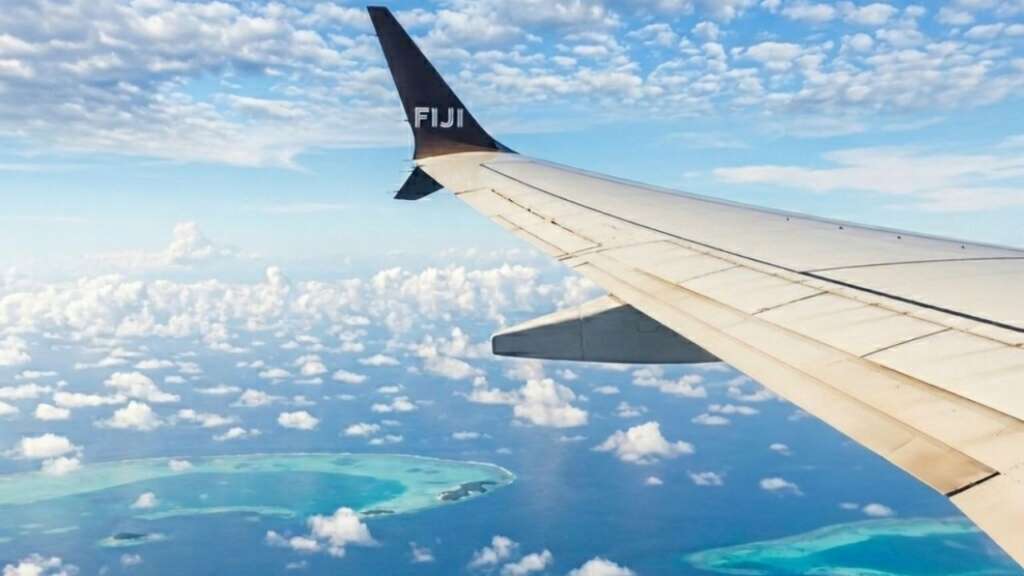
Fiji Airways has now built an entire business case around this exact combination – with their “Ski-Ji” concept appealing to Aussies peeling off to the slopes of Whistler and the Rockies, and routing through 80-odd square kilometres of turquoise reef and reggae-inflected kava bars on the way. Ice skate in Canada, but first, get a tan.
It’s the kind of itinerary that sounds like a booking-engine glitch until you realise Fiji Airways proposed it on purpose – the national carrier’s whole modern pitch to North America-bound flyers is built around a free stopover of up to 72 hours, worked into the fare with no asterisk required.
My own opportunity to incorporate an extended transit in the South Pacific arrived sideways. In the way these things usually do… I discovered that Jetstar had discreetly discontinued its budget Sydney-Hawaii route (RIP return trips to the USA for under $1000), and was forced to rethink my options for securing an upcoming flight to the Aloha State for less-than four figures.
Rather than mourn the cancellation, I decided to make the disruption work for me.
Fiji, a destination I’d been mentally filing under “one day, with a plus-one,” got added to the itinerary instead. The plus-one was not currently in the picture. The mud bath, as it turns out, did not mind
With two and a half days on the ground, here is what’s actually achievable. No honeymoon required.
Half Day One: Nadi Earns Its Reputation
Nadi has a reputation as a place people pass through, eyes fixed on the Coral Coast. This does the town a disservice, because even a scant six hours is enough to cover three entirely different Fijis between lunch and dinner.
I started sensibly enough with an airport pick-up by my friendly local driver Sunny Ram (Get him on WhatsApp number + 679 936 1375 if you’re heading that way). And, a drive to the Sri Siva Subramaniya Temple complex. Here, sits the largest Hindu temple in the Southern Hemisphere – and a cacophony of carved, candy-coloured deities looking startlingly ornate against Nadi’s low-slung, corrugated-iron skyline.

It’s a reminder – before you’ve even had your first cup of kokoda – of just how thoroughly Fiji’s story is bound up with the 19th-century indentured labourers brought over from India to work the sugar plantations.
Today, it is a history that continues to show up in the food, the language, and roughly half the surnames on the island, long before it appears in a guidebook.
From there it was on to the Garden of the Sleeping Giant, a former orchid collection planted by actor Raymond Burr (who knew that Perry Mason moonlit as a Fijian horticulturalist?) and now home to thousands of varieties sprawled beneath a mountain range that does, from the right angle, resemble a giant having a lie-down. It’s unhurried, shaded, and the correct antidote to a body that still thinks it is 2pm and is preparing for an afternoon nap.
The finale was the Sabeto mud pool and hot springs – a set of geothermal, volcanic-clay pools bubbling up from beneath the Sabeto highlands. You cake yourself grey, bake in the sun until it cracks, then rinse off in the adjoining hot spring, feeling – reports suggest, and I can now confirm – several years younger and considerably softer. It is messy, it is cheap, and it is without competition, the best thing to do when battling brain fog courtesy of a dawn-departure flight.
Easy accommodation: The Palms Denarau – more like a fancy friends’ flat rather than a full resort, this apartment-style suite sits directly opposite Port Denarau Marina, so the boats, the bars, and the buzzing day-trip desks are a two-minute stroll rather than a taxi fare. The self-contained kitchenette also means that when jetlag finally hits, you can swap a late restaurant dinner for an in-house option you can tuck into while you are tucked in.
At the end of the day (literally), for a stopover where every hour counts, I believe that “opposite the port” beats “beautiful but 120 minutes from anything” every time.
Day Two: Island Hopping, Denarau-Style
With a good night’s sleep under my belt, day two delivered a multitude of moments where Fiji stopped being a layover and started being the place that people actually save up for. Sun. Sand. Snorkelling. And a spectacular introduction to Bula Life. Island style.
Your best bet is to pick things up in Port Denarau – the departure point for the Mamanuca Islands – and a brilliant base to discover the famed scattering of postcard-perfect specks visible, tantalisingly, from the mainland.
Castaway Island is the full-resort day-pass experience: seven hours on a gorgeous stretch of sand, non-motorised watersports thrown in, and a lunch that leans buffet, but plates up much more than crusty mac and cheese and dry fried rice.
South Sea Island is smaller, punchier, and built for people who want maximum snorkelling-to-effort ratio. Plus, a backup saltwater pool for those who’d rather not get their hair wet.
Or, try Malamala Beach Club, the newer arrival on the circuit, which plays a different game entirely: Cabanas with butler service, an a la carte menu of beach club classics (Fish tacos! Chicken sliders! Coconut water in its shell!), and a backdrop begging for a spot on your social media grid.
Day 3: Committing to a Resort
By day three, the stopover mindset – squeeze in one more thing, keep moving – started to feel like the wrong energy entirely. So, my final Fijian stretch was deliberately, defiantly low-key: pick one resort, and don’t leave.
I committed to the Radisson Blu Resort Fiji Denarau Island, and the welcome alone immediately gave away what sort of stay this was going to be. There was a Gospel-esque guitarist strumming at the entrance, and a reverberating drum gong that greeted me as soon as I disembarked my open-air Bula Bus. (Is there any other way to navigate these parts of town?) Plus, a cold towel and a glass of fresh juice pressed into your hands before you’ve even given your name at reception. It’s the type of theatre that could feel cynical at a 268-room resort with a well-earned reputation. It doesn’t. It reads more like a routine they’ve performed several thousand times and still mean.
The rooms backed that reputation up: blonde wood furniture, oversized headboards, soft blue-and-grey furnishings, and colourful artwork by Fijian visual artist Maria Rova. Each had a private balcony or ground-floor patio, with one and two-bedroom suites coming with a full kitchen and laundry – a detail family travel bloggers love to hashtag.
I had neither a sexy plus one nor small children in tow. Instead, I scored a king bed, a stocked minibar, and approximately 11 hours of nothing scheduled, which, after two days of moving, felt like exactly the right allocation.
I started at the beach itself. Honest rather than glamorous, Denarau’s sand runs slightly beige rather than the white-flour Mamanuca variety, and there’s a rock barrier doing quiet erosion-control work just offshore.
Fortunately, it soon transpired that a four-part lagoon-style pool plan partnered with some top-tier tiki-torch decor was the better metric by which to judge a Fijian resort day.
Here, kids under the age of six could be heard giggling from the whitewater tunnel slide; those who looked like smug newlyweds canoodled in the adults-only lagoon pool; and then there was me – taking full advantage of the swim-up bar pool, where the loudest sound was that of ice against my cocktail glass.
Insider tip: Ask for a lagoon-view room, and you get to watch the whole operation from your balcony before you’ve even changed into swimwear.
An appointment at the Harmony Retreat spa didn’t make the cut this trip, but the coconut-and-frangipani products on display made a strong case anyway. The lime blossom body peel is now top of next trip’s to-do list. Mud-bath glow, minus the volcanic sludge.
What I did have time for was eating. And with over six restaurants to choose from, dinner was never going to be a problem.
Blu Bar & Grill handles the all-day beachfront basics – a heaving breakfast buffet, sunset cocktails on the deck, grilled mains at night, while Chantara does Thai with its own specialty chef. Basilico covers Italian, Byblos brings Lebanese into the rotation, and Teppanyaki sits on the sizzle-and-theatre end of things.
But, the one booking worth making before you land is Lomani Wai – Fijian for “in the water” – where a three-course dinner is served to you barefoot, seated in the shallow end of one of the lagoon pools, while fire dancers and live guitar work the deck around you.
It sounds like a gimmick engineered for a hotel brochure. Novelty-over-substance. It isn’t. TripAdvisor reviews of the experience read with unusual unanimity for a resort restaurant, and platitudes like: “extravagant,” “unforgettable,” “would be extremely hard to top” turning up again and again from guests who otherwise have nothing else in common.
So is a Fiji Stopover Worth It?
I flew to Fiji expecting a good-enough but geographically convenient inconvenience on the way to my final destination. I left, two and a half days later, doing the mental arithmetic on how to build an actual return trip around it, ring or no ring.
The stopover-as-waste-of-time camp still has a point when the layover in question is eight hours in a fluorescent-lit terminal. But when an airline hands you 72 hours, first-rate island infrastructure, and a mud pool that outperforms most resort spas, “waste of time” stops being a credible position.