

The cutlery sleeve was the first thing I noticed as I prepared to tuck into a foil-covered lunch of chickpea curry on my Fiji Airways flight from Sydney to Nadi. It was paper, not plastic. Slightly rough under the thumb.
One end carried a printed reminder that the FSC-certified wooden cutlery inside came from sustainable material. And, on the other side sat a Su-ni-lolo (traditional Pacific Island motif) alongside an invitation to enjoy “a special meal for a visitor [that] celebrates family coming together.”
It was such a small object to carry so much weight. And, yet, by the time I landed in Viti Levu for the first time in my life four hours later, I had come to recognise that same sleeve as the opening line of a much longer story – about Fiji’s status as the Land of Bula Smiles
But, there and then, somewhere over the Pacific, I was simply a traveller with time to kill, who had just re-watched The Barbie Movie for the third time, and was now questioning the role of a national airline as cultural ambassador: Wondering whether you could really taste a country before you’ve set foot in it? Hear it, before you understood a word of the language? And feel its values before anyone explains them to you?
Fiji Airways FJ 914, answered, in increments. And the resonse was yes. Confirmed in a chord change, a cup, a folded flower, a blessing over the intercom. And the opportunity to live the Island life long before I landed.
Sounds of the South Pacific
Somewhere past the midpoint of the flight, I put on my headphones, and a gospel choir came on first, full-throated and unhurried, with harmony that sounded as though the spirit of Aretha Franklin had supervised the recording session. Three tracks later, a Hindi film number began, its string section swelling under a chorus of voices. Nobody explained the pairing. It was simply there, one culture’s Sunday morning sitting next to another’s Saturday night at the cinema, and the two nestled together without friction.
It said more about Fiji than any guidebook paragraph could. The islands carried both a deep Indigenous heritage and a large Indo-Fijian community, descended from labourers brought over generations ago from India – two histories, two soundtracks, one country.
Then there were the voices closer at hand – the crew’s, warm and unhurried in a way that resisted the clipped, over-rehearsed cadence other carriers trained into their staff. Someone laughed, genuinely, two rows back. It was, before anything else on this list, the first sound of somewhere else.
Flavours of Fiji
A peek into business class further plated up the case for travelling a nation’s national airline. Here, the crew poured short measures of gin, pale gold and faintly herbal on the nose.
It was Blue Turtle, made by The Distillery Co. from sun-dried kava and citrus peeled entirely by hand. Much of the cutting, I was told, done by women from villages neighbouring the distillery.
“It feels good to be on an airline that is truly Fijian,” the company’s head of sales, Pate Sawani, has said of the partnership. And there was truly something special about drinking a spirit made from local labour while still hours from seeing a single village.
The chocolate that followed had a slightly more unconventional – albeit no less delicious – backstory: an abandoned cacao tree, and a Japanese transplant named Tomohito Zukoshi who, 20 years into life in Fiji, had decided the forgotten pods deserved rescuing.
Every stage – fermenting, sun-drying, roasting, tempering – happened on Fijian ground, by hands he described simply as “all local.” It snapped cleanly, tasted faintly smoky and disappeared far too quickly. His ambition for it, in his own words, was almost naively simple: to pass on “the seed of happiness from the cacao tree to everybody.”
Two products. Neither had been engineered for an airline’s private-label catalogue. Both had been made by people who lived minutes from a beach I had yet to see.

Colour, Craft and Culture
Beside the tray, sat a single paper rose – folded, bark-thin and precisely creased. Wati Walawala, a local Fijian woman from Ono-i-Lau, made it, having spent over a decade turning hibiscus bark into these small blooms, known as vau. The process started at the shoreline: bark cut, soaked in seawater, dried under direct sun until it separated into layers, one of which was soft enough to shape. “This small rose,” she’d say, “makes me fly.”
Come coffee, and the cup arrived before the caffeine did – louder than everything else on the tray – with a wash of colour, bold looping pattern against white china.
It was the work of Maria Rova and her team at Siga Vou Studios, a business that had started, by her own account, “at the kitchen counter at home.” The pattern borrowed its rhythm from masi, Fiji’s traditional bark-cloth art – the same dabbing motion, translated into brighter colour and a looser hand. “We want them to feel the warmth of the Fijian hospitality,” she’d said of the design, “the Fijian people, the Fijian culture, the Fijian colours.”
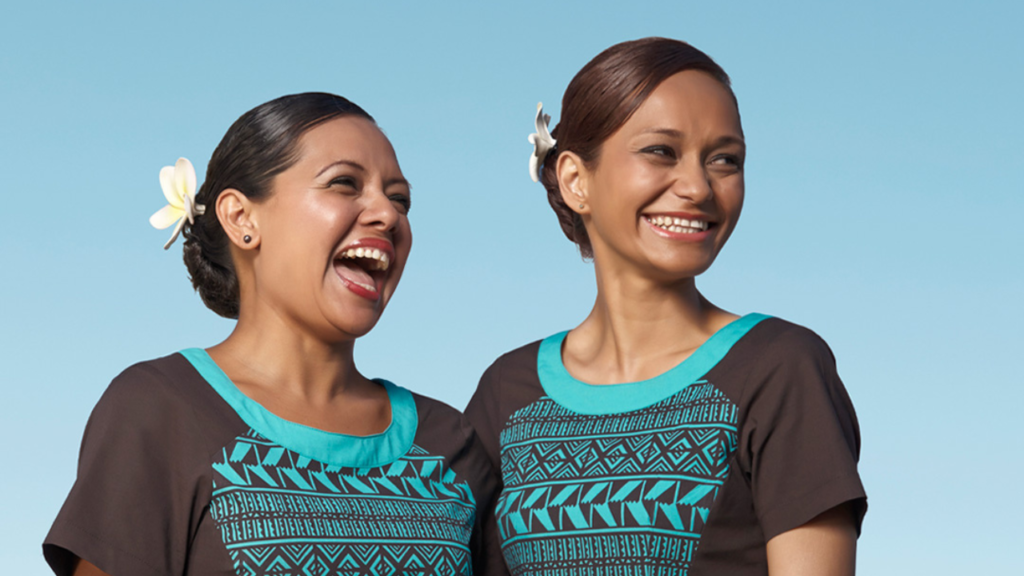
And finally, on the crew themselves, a print that wasn’t decoration but language – masi motifs translated onto fabric by Fijian-based French designer Alexandra Poenaru-Philp, in a palette that read like the exceedingly closer view outside the window: aqua for sky and sea, brown for a colour carrying real weight in Fijian tradition, tied historically to chiefly authority and respect.
Fijian masi artist Makereta Matemosi explains that the motifs aren’t abstract. Instead, one stood for friendly service, another for open sky and cool sea breeze, a third for unity in shared work. Looked at closely enough, my attendants sleeves became a small, wearable dictionary of what the country valued.
Vinaka for the visual vocabulary
With a warmth that was impossible to miss, and even harder to fake for four hours straight, the Fijian concept of bula vinaka (good life) continued to show up in small, almost throwaway gestures on my flight.
In a pillow passed, without being asked, a second offer of water before I’d finished the first glass, and a print on the cutlery sleeve about conserving the ocean the plane was crossing.
The word behind it, I later learned, was Maro Roya – to protect. It surfaced in the bamboo blanket on my lap, later donated rather than discarded; in the plastic quietly phased out in favour of paper and pulp; in the mangrove sapling planted, by the airline’s own account, for every take-off – more than 98,000 trees now standing between Fiji’s shoreline and a rising sea. Easy to miss entirely if you weren’t looking, this was care, offered without an audience – which I tended to believe may well be the most convincing kind…
Faith, Family and Fiji Feels
Finally, as descent began, and the pilot’s voice came over the cabin – it was not gate numbers nor directions pertaining to a flight delays, but a prayer-like statement first that truly separated the distance between now and my secular starting point in Sydney (which suddenly appeared so much more than merely 3,170 kilometers away)
“God bless and wishing you a blessed trip,” said the pilot.
It was a small sentence, and an unusual one by the scrubbed-neutral standards most airlines trained into their crews. However, Fiji’s Christian roots sat close to the surface of daily life there, and the airline didn’t sand the sentiment down into something safer. No hedge, no generic “safe travels” standing in for it. The pilot delivered the blessing plainly, the way a host might say it at their own front door, because by then, in every way that mattered, that’s roughly what this flight had been.
A Perfect Landing
By the time the wheels of flight FJ 914 hit the runway of Nadi International Airport (NAN), located on the western coast of the main Fijian island of Viti Levu, I knew that I had heard the country before seeing it. Tasted it before setting a single course at a restaurant. And, been welcomed into its values before clearing customs. And, none of it had required leaving my seat.