

There are many fabulous cities to visit, slowly explore, and rest in. Hong Kong, my friends, is not all this.
Hong Kong doesn’t gently welcome you in, she grabs you by the hand, pops you on a tram, feeds you (a lot), points you towards a ferry, and by 9 pm she sticks you in a bar hidden behind an antique shop, wondering what she’s going to throw at you next.
Fresh (definitely not the right word, but we’ll run with it) off an overnight flight and a 7 am arrival, Hong Kong welcomed me with humidity, harbour views, a cold beer at breakfast and the immediate sense that rest had been removed from the itinerary.
Hong Kong wasn’t actually meant to be the main event. It was the stopover, a brief pause with a loose itinerary and an exceptionally fun travel buddy, before two demanding weeks in Taipei, which kind of made it feel all the more urgent. We had 72 hours to cram in the fun, the food, the cocktails and the culture before more serious behaviour took over.
We based ourselves at The Hari in Wan Chai, which was an excellent decision. The hotel, whilst small in room size, gave me just enough polish to pretend this was a sophisticated stopover, while the streets outside quickly corrected that assumption. Wan Chai was not a soft landing. It was street-level big-city lights: markets, cafes, traffic, old shopfronts alongside new boutiques, trams, towers and more than enough chaos to make you feel immediately part of the hum. I immediately fell in love.
My first morning started with a quick freshen-up in The Hari reception bathroom, where they were exceptionally accommodating and clearly well prepared for early-morning arrivals. From there, we walked through Wan Chai, wandered the Starstreet Precinct and settled into a super healthy breakfast washed down with an ice-cold beer.
Please don’t judge. It was steaming hot, and I stand firmly by that beer. Travel rules are different. The Starstreet precinct was delightful. Little pockets of hidden boutiques, cafes, and small galleries give it a cool, creative edge without trying too hard.
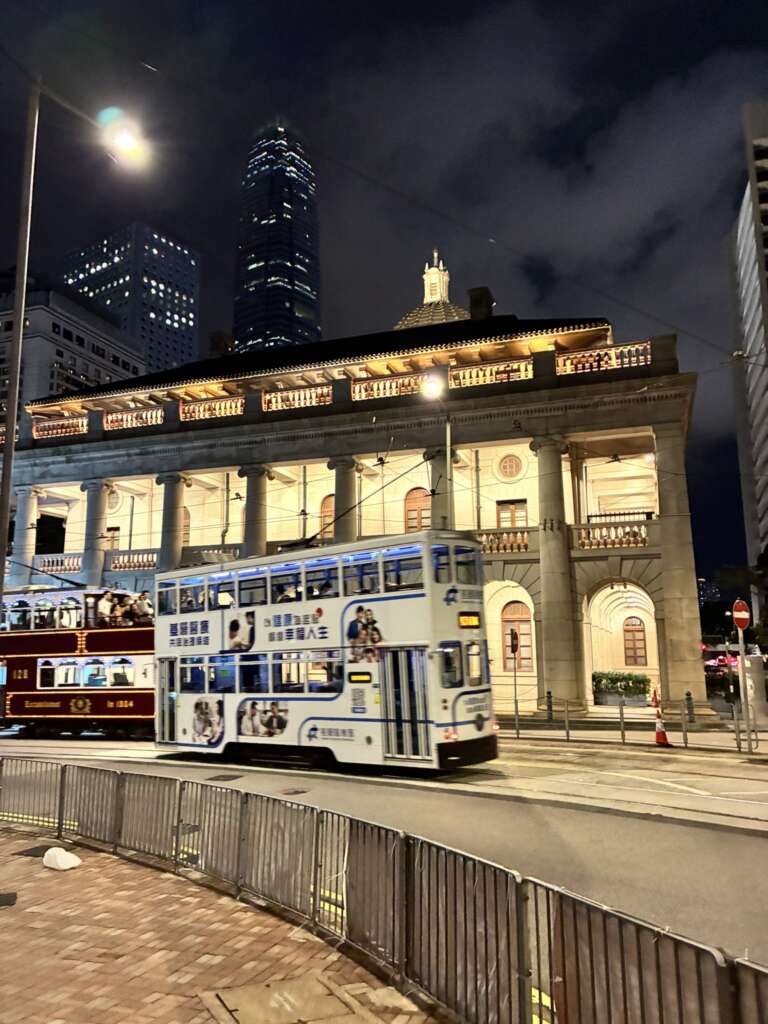
Oh, and the Ding Ding tram, so much fun. Hong Kong’s double-decker trams are slow, deeply impractical if you are in a rush, and packed to the point of standing room only – my idea of hell, which is exactly why I loved them. They move through the city with the charming grace of something truly unique that has survived every bad idea urban planning ever threw at it. From the top deck, the streets put on a show. Pedestrians slide past, neon shop signs stack on top of each other, market stalls and skyscrapers all press in together and in amongst it all, the tram bell proudly dings, as if the whole city is being politely told to make way for the matriarch.
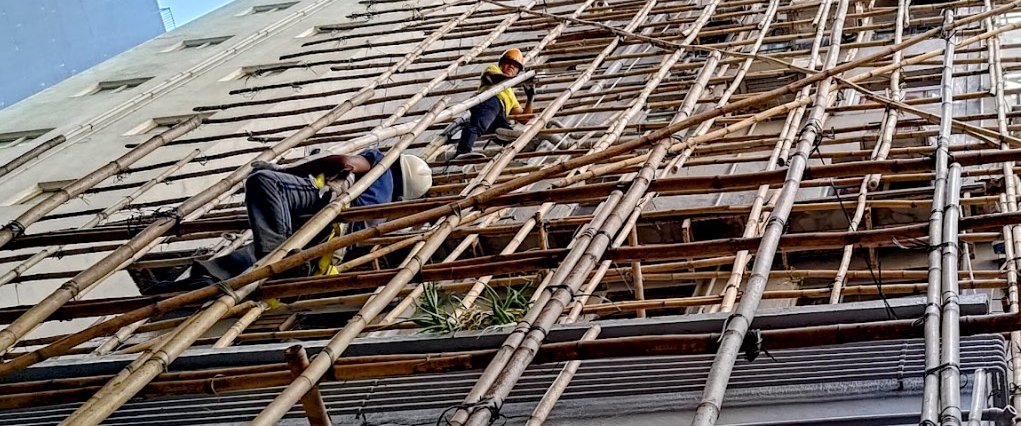
At every turn, bamboo scaffolding and zip ties cling to buildings like a second skin. This old construction method, wrapped around modern towers, is beautiful, terrifying, extraordinarily skilled, and, after recent fire concerns, the old craft is slowly being phased out, now more complicated than it first appears. Some might say this sums up Hong Kong in a sentence: ancient craft, modern pressure, impossible density and everyone getting on with life around it.
By afternoon, I had showered, stretched and convinced myself I was ready for a 10-course food tour.

The tour took us through Old Town Central and Sheung Wan. Sheung Wan was probably my favourite district. It gave me that wistful travel feeling where you know you are only passing through but can very much imagine an expat life there. The streets were layered and lived-in, with dried seafood shops, herbal medicine stores, old family kitchens, hole-in-the-wall wine bars, antique shops, steep lanes and small cafes all sitting comfortably beside each other.
It was a tiny bit gritty, my kind of stylish, and completely absorbing; every doorway seemed to hide either a long-held generational tea shop, old, dusty treasures, or a very good glass of wine.
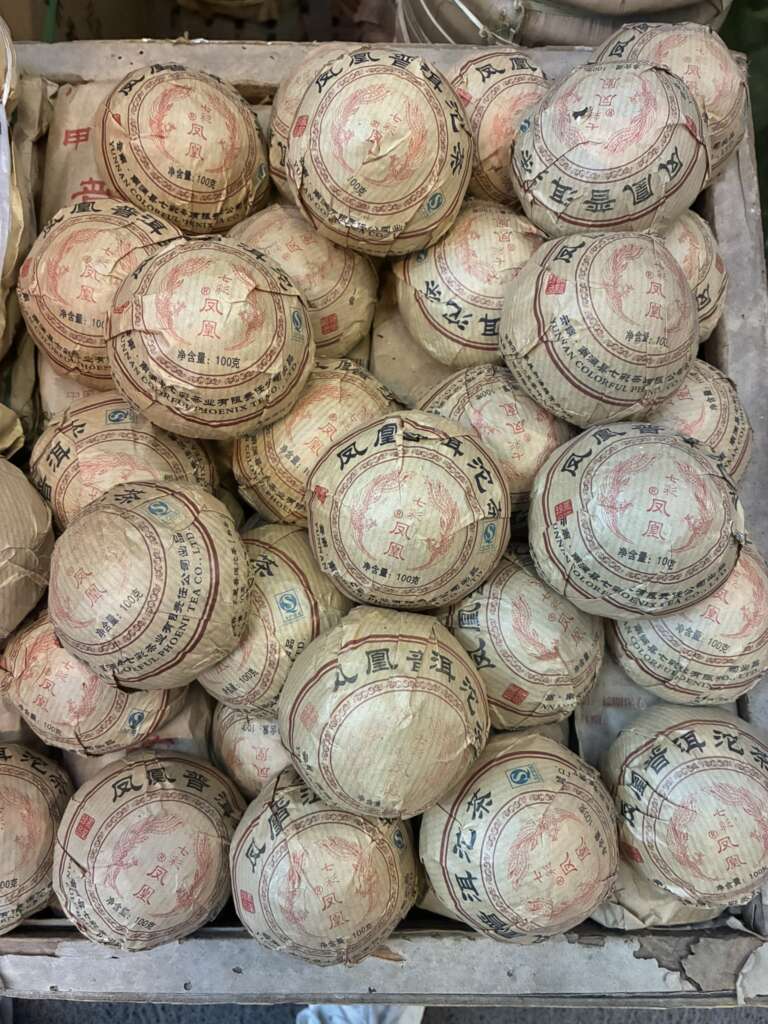
We tasted silk-stocking milk tea, which is neither made with nor strained through old silk stockings, though I admit I needed that confirmed. We ate Hong Kong-style French toast, which is not particularly French and, frankly, despite my excitement, didn’t quite work for me. Some truly marvellous BBQ pork and duck, and the dim sum- well, we ate some and then some. My husband and daughter are major fans of dim sum, and it gave our walking food tour its deepest historical thread. The broader tradition grew out of the Cantonese teahouse ritual of tea, and my search for the best dim sum on the Gold Coast has now commenced.
It was a steaming-hot Hong Kong evening, so our firecracker host, Jade, made us stay put while she downed a rehydrating watermelon and ran out for egg tarts as we inhaled our pork and duck. My one regret was not following her to meet the maker of the egg tarts she returned with.
Those egg tarts were my standout. Still warm, flaky and golden, she shared with us their history, which is far bigger than their size: part British, part Cantonese, part cha chaan teng comfort food. Side note: a cha chaan teng is Hong Kong’s everyday cafe, fast, noisy and practical, serving milk tea, pineapple buns, egg tarts and not-very-French French toast to a city that doesn’t do a slow breakfast.
The Hong Kong egg tart, or daan tat, is best described as a Cantonese reinterpretation of the British custard tart. There are two main Hong Kong styles. One has a shortcrust shell, more buttery, crumbly and biscuit-like. The other has a flaky puff pastry shell; I went with the latter, still vaguely warm and stick a fork in me, I was done.
But the tour was not.
Noodles and wonton and then herbal teas with names like Five Flowers and 24 Flavours, which sound lovely and whimsical until you drink them and realise they are purely functional, bitter and strong. Evidently it’s the herbal tea you drink when Hong Kong’s humidity has entered your bloodstream, and your body needs a reset.
We learnt that Hong Kong food in its traditional format doesn’t separate pleasure from function. A drink can be refreshing, bitter, medicinal and social all at once. A snack can carry centuries of trade, poverty, migration and family adaptation, then arrive in front of you on a plastic plate. A bowl of noodles can feel simple until someone explains the broth and you learn that simplicity has been a recipe passed down through the family for generations.
By the end of Day 1 and my 10th plate of food, I was full, highly informed and completely happy.
The next morning, in a desperate attempt to prove I still had some self-respect, I walked along the harbour front. Hong Kong Harbour in the morning surprised me. The water was calm, runners sprinted by with the energy of those who hadn’t eaten their body weight in dumplings the day before, the harbour pool was crying out for some lap swimming, and the view across Victoria Harbour to Kowloon felt almost serene.
I am a great lover of city harbours and Hong Kong doesn’t waste its waterfront. When you stand there, with all the buildings rising on both sides and ferries cutting across the water, like all great harbours it makes the city feel alive.
My first international trip was to Hong Kong with my family when I was a sullen teen, maybe 18; I don’t remember much, but I do remember deliberately getting lost in the city, walking until I had no real idea where I was, simply because I could. Standing on the Wan Chai harbourfront some 35 years later, looking across to Kowloon, the memories came rushing back, faster than I could name them. The smell, the heat, the noise, the thrill of being young in a city that felt impossibly huge.
Turns out I hadn’t forgotten Hong Kong after all; she’d just been waiting for me by the water.
Before brunch, we made a retail detour to Times Square in Causeway Bay, dipping into our retail stamina. Times Square is one of those big Hong Kong shopping landmarks packed with enough fashion, beauty, food and lifestyle stores to make “just a quick look” a total lie. It wasn’t the most soulful stop of the trip, but it was a quick fix ahead of a long and lazy day of Hong Kong dining.
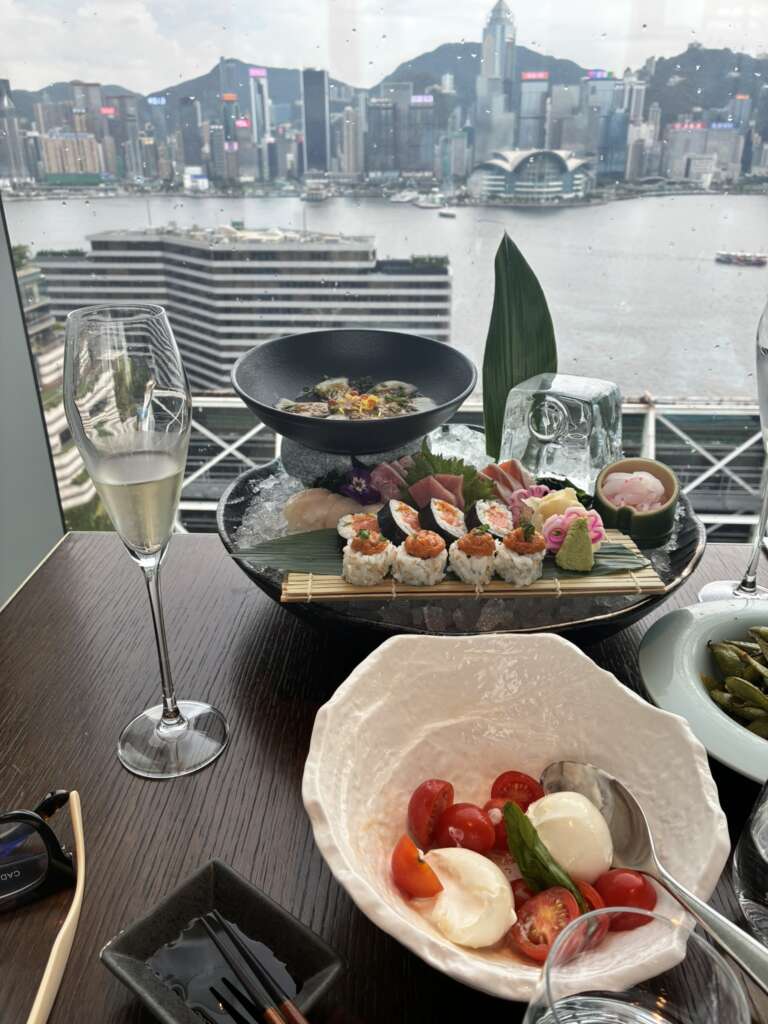
Perched above Victoria Harbour in Tsim Sha Tsui, Aqua delivered the fancy brunch that I’m told Hong Kong does so well: bottomless Clicquot with a ridiculously kind pour, and a feast that showed no restraint. Sashimi, Oysters, Hamachi, burrata, tomato and basil salad, pork gyoza, prawn tempura, an in-house DJ and dessert to die for. My mate likened the whole experience to Twenty Thousand Leagues Under the Sea in a sky-high restaurant; he reckons there was something wonderfully Jules Verne about it: glass, polish, seafood, theatrical lighting and the overwhelming sense we had boarded a very expensive submarine with sublime service and French champagne. It was fabulous, excessive, and completely unserious in the best possible way.
After a quick pitstop at the rooftop bar (like we needed another Cliquot), we hotfooted it over to the Mondrian Hong Kong and Avoca on the 38th floor. I found it modern, stark, and a little harsh. Some hotels want to wrap you up in warm velvet; others want to test your architectural resilience. I admired it more than I warmed to it, which is a really polite way of saying I understood the design but didn’t feel the need to move in.
The Spritz still did the trick.
Later that same evening, we found a corner seat in the Sky Lounge at the Sheraton and hoped for the full Victoria Harbour spectacle. Instead, a heavy storm swept through and swallowed half the view, which felt very Hong Kong to me; even the weather puts on a show. We caught glimpses of the harbour light show through the rain, enough to understand why A Symphony of Lights has been one of the city’s signature shows for more than two decades. It now appears to be in its final act, with Hong Kong preparing to replace it with new festivals across different locations. There was something fitting about watching it half-obscured, an old spectacle flickering through the storm before eventually transforming into something completely new.
Day 3 brought another flood of late teen memories.
The Star Ferry may be one of the best harbour travel experiences in the world, second perhaps to the Manly Ferry. It’s cheap, practical and stunningly magnificent. The ferry meanders across Victoria Harbour, passing oversized cargo with complete confidence, comfortable in the knowledge that no rooftop bar can ever fully compete with sitting on a wooden bench while Hong Kong Island rises in front of you. I loved the nostalgia of it all, slowly crossing the harbour, while I sat in my memories and let the city show off around me.
From Kowloon Wharf, I went to M+, Hong Kong’s museum of contemporary art, where my “cultured” claim becomes legitimate. I loved M+. In particular, I loved the Lee Bul exhibition. The South Korean artist’s work was moving, futuristic, feminine and unsettling in the best possible way. Her work felt like it belonged to Hong Kong, a city also obsessed with structure, ambition, technology and the tension between beauty and control.
M+ was a brief stop that shifted the trip from excess to art. There was even Dial-A-Poem Hong Kong (a global project established in 1968 by poet John Giorno), where local poets in Cantonese, Mandarin and English could be heard through old-school telephones, a lovely reminder to stop and acknowledge that poetry will always find you.
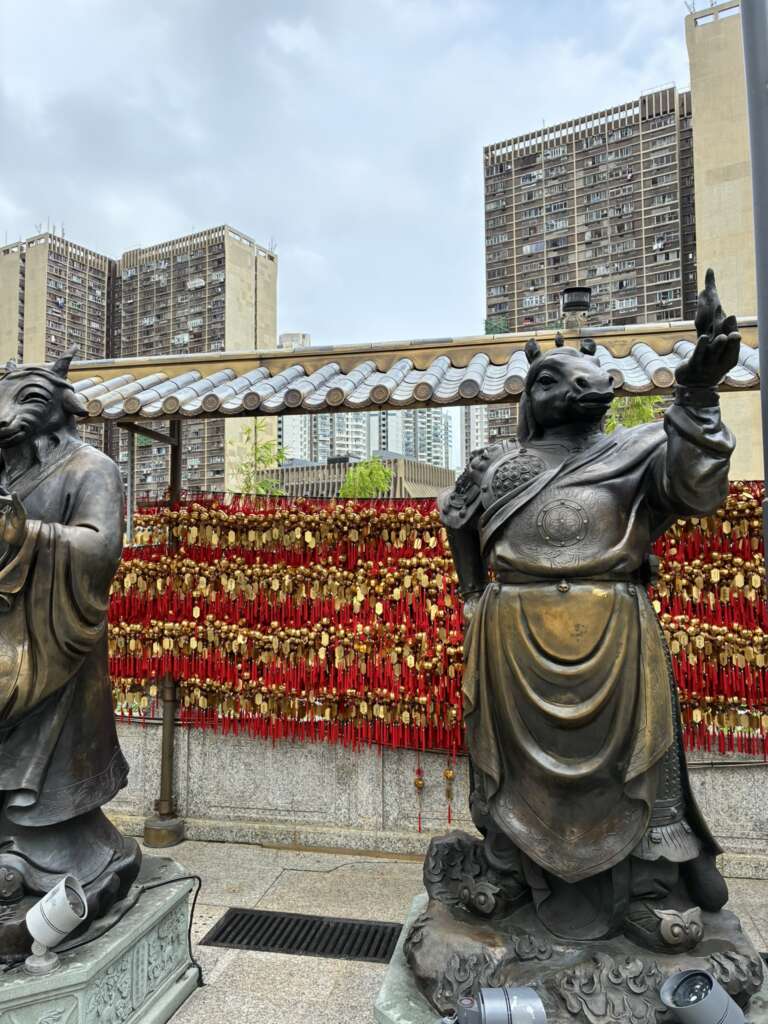
Day three was a solo morning, so I squeezed in a quick cross-town trip to the Wong Tai Sin Temple. I wanted to love it; I really did. I went in hoping for reverence, maybe a spiritual moment and a small glimpse into my future fortunes; I felt like that wasn’t a lot to ask. Wong Tai Sin is famous for fortune-telling and kau cim, in which you shake a bamboo cylinder over quiet prayer until a numbered stick falls out, and someone (a computer in this instance) interprets it. In my imagination, this was going to be profound. In reality, I found it more transactional than transcendent.
This is not a criticism of the temple, which is an active place of worship and clearly meaningful to many people; I guess it’s more of a confession about my own expectations. Sometimes travel makes me greedy for revelation; I arrive wanting the universe to send me a message, preferably one with a beautiful arc and a flattering outcome. Instead, I got noisy queues, electronic instructions and a reminder that spirituality doesn’t exist to perform for tourists.
So, I left slightly disappointed, but certainly more accurately calibrated and ready to meet my mate for Yum Cha at Serenade back in the cultural precinct.
We eventually took the MTR back to Wan Chai; Hong Kong is brilliant at moving people around. The trains are clean, fast and ruthlessly efficient. The hot tip is to preload an Octopus card so you can tap and go without thinking. No small-change panic; the card (download it to your phone) can also be used in taxis, Maccas (if that’s your thing) and on the late-night 7- Eleven run for Pocky sticks and H20.
If first-night fever marks the delirious arrival of holiday energy, then our final night was all about last-night defiance, one final push to wring every cocktail, cab ride and neon-lit corner out of Hong Kong before two weeks of hard work took over.
We headed into Central and the old police barracks precinct, now Tai Kwun, which is one of those places Hong Kong has repurposed well. Tai Kwun means “big station”, the local shorthand for the former police headquarters. For more than 180 years, this walled compound held the machinery of Hong Kong’s colonial justice system: the Central Police Station, the Central Magistrature and Victoria Prison. People were arrested, charged, tried and detained all within the same dense cluster of buildings.
By day, that history might feel heavy, but by night, with the courtyards lit and the old stone softened by restaurants, bars and neon lit art spaces, the compound, a former place of discipline and confinement, becomes one of the city’s most atmospheric places to wander, and our last-night defiance took us in and around the compound on our last hurrah and a “small bar” hop.
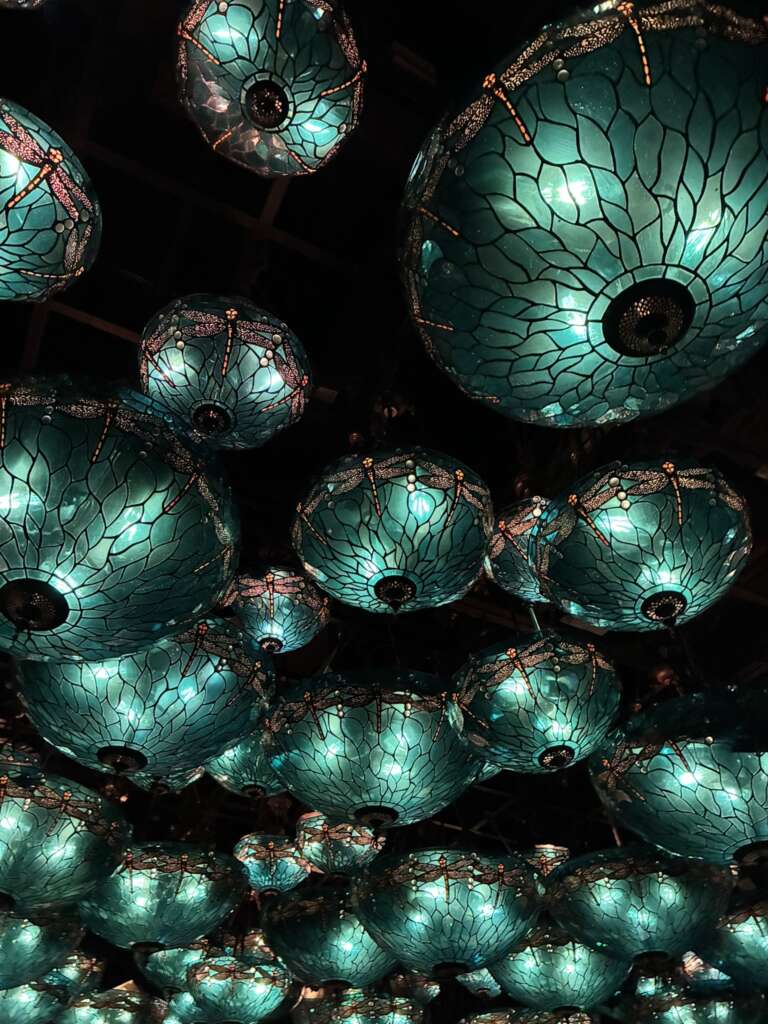
Dragonfly was divine. It felt like stepping into a magical jewel box. It was a Tiffany-style fever dream of jewel tones, dragonflies, low light and Art Nouveau excess.
We got gloriously lost in the barracks trying to navigate our way to 001, a speakeasy bar that made it clear Hong Kong likes you to earn your drink. Hidden bars are ridiculous, of course; everyone knows they exist. But there is still something thrilling about that extended pause at the entrance, when you know you are being assessed by a hidden camera scrutinised before entry, followed by the cheap relief of a hidden door opening and the realisation that you have just scraped through on the barometer of cool.
But the final act belonged to Maggie Choo’s.
Maggie Choo’s is hidden behind an antique shop on Hollywood Road, all 1930s Shanghai, low-light cabaret and very deliberate cool. It had a Baz Luhrmann, Moulin Rouge kind of excess, and I half expected the green fairy, Kylie or Satine herself, to swing in from a chandelier at any moment. Once inside, I immediately forgave myself for being out far later than planned. There, on the tiniest stage, was the most fabulous female vocalist doing a damn fine job on Roberta Flack’s rendition of Killing Me Softly.
I was ready to settle in for the long haul. The lead singer, however, appeared to have other plans. He barely let her get another note in for the next hour. She had the voice, but he had the microphone. We imaginatively decided the band was being funded by Daddy’s trust fund. It had that unmistakable energy of a man who lacked the talent but had somehow been given the stage, the set list and, presumably, the fiscal support from his family office.
Still, the night was fabulous.
Maybe that sums up Hong Kong. It doesn’t need every element to be perfect; sometimes the slightly obscure becomes the story. The underwhelming spiritual moment, the overconfident lead singer, the light show nearing retirement in a Hong Kong storm, and that fabulous ferry that outshines it all.
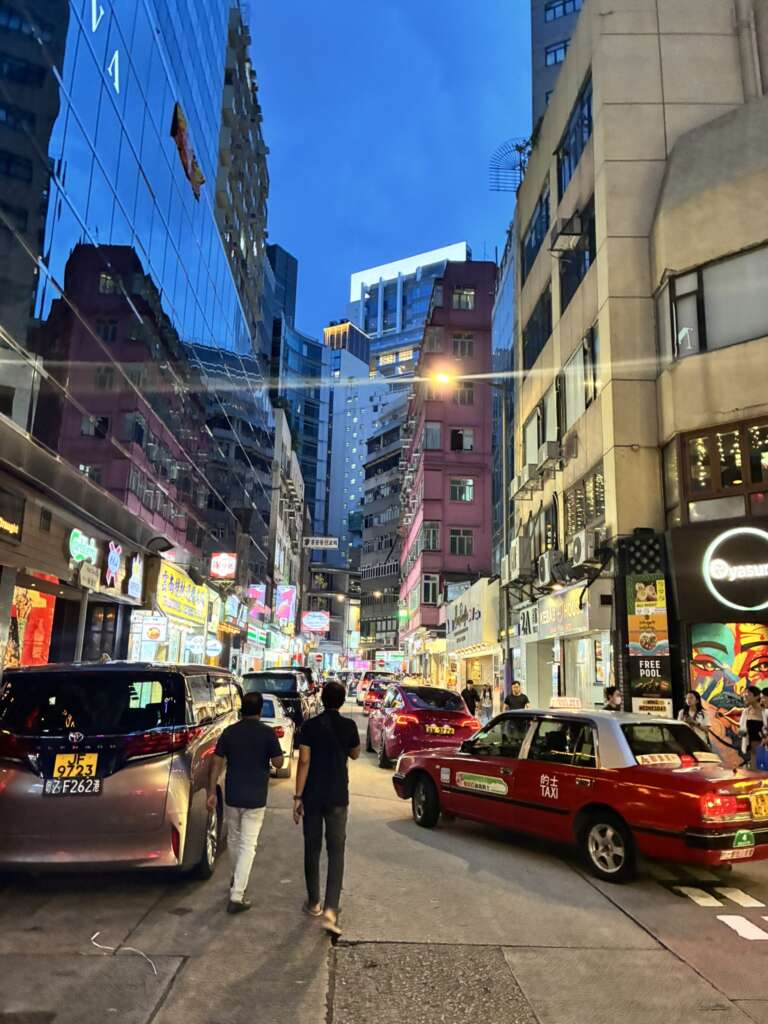
Over three days, we moved by red taxi, MTR, tram, ferry, and foot. We crossed from Wan Chai to Sheung Wan, from Tsim Sha Tsui to the West Kowloon Cultural District, from markets to museums, from temples to cocktail bars. We ate too much, walked enough to justify it, and found ourselves on high-repeat, saying, “God, this city is fabulous,” with the joyous admiration usually reserved for brilliant women and poorly behaved friends.
Hong Kong is definitely not restful, and she’s not gentle; she doesn’t care if you’re tired; she expects you to keep up, but she is wildly alive and free, and for 72 hours, she was exactly what I needed.
