

The journey from Udaipur to Rawla Narlai is an unfolding tableau of rural Rajasthan. Driving past water buffalo and Brahmin cows standing idly in the middle of roads while monkeys watch on, my husband Jo and I felt the subcontinent slowly give way to a deeper enchantment. A few hours on, we arrive at a genteel royal hunting lodge turned five-star oasis, tucked away in a tiny 17th-century enclave.
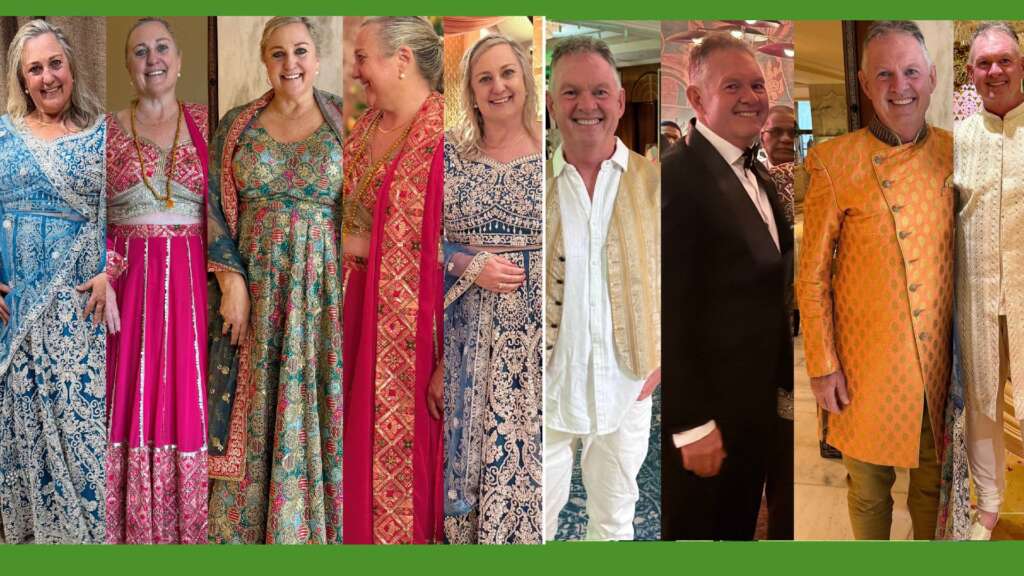
Jo and Robyn, bejewelled from head to toe in keeping with the three-day Indian wedding dress code.

Having just come from a whirlwind three-day wedding in New Delhi followed by a few days in Udaipur, it is time to relax and soak in the rich character India has to offer — and Rawla Narlai certainly doesn’t disappoint. Gifted in the early 20th century to Maharaj Dhiraj Sir Ajit Singh Ji by his elder brother, H.H. Maharaja Umaid Singh Ji of Jodhpur, the property boasts history as authentic as it comes: owned by the royal family and part of their once princely state for over 300 years.
Stepping through the gates, we are greeted with an abundance of warmth and hospitality by staff dressed in traditional Rajasthani attire. From the moment we set foot in the frangipani-scented courtyards, framed by striking white architecture blanketed in cascading magenta bougainvillea, we knew we had found somewhere extraordinary. The heritage hotel sits right on the edge of a dramatic granite hill known as Elephant Hill. The 350-foot-high single volcanic rock looms overhead, dotted with ancient temples and shrines that catch the golden evening light.
It is charm personified. Staying here feels like staying inside a living museum, filled with original artefacts, fabulously ornate design elements from the Rajasthan royal family, and historic photos of Maharajas lining the walls. One cannot help but wonder what stories these walls could share. Situated in the small village of Narlai, you can take a stroll and watch village life unfold as it would have over the centuries, in the same quiet and unhurried way.
Eighty per cent of the town is Hindu; the rest are Muslim, along with a few people of the Jain faith. Much can be learned from the men’s turbans — silver tinsel, for instance, is a sign the man is married.
We enjoy a refreshing swim in the pool, overlooked on one side by chic, contemporary tents built for guests that blend rustic charm with plush royal comforts, while on the other side a huge open courtyard stretches wide towards the guest lodgings.
Visiting in mid-September, at the end of the shoulder season, means there are surprisingly few other guests staying, and we feel blessed to have so much of this idyllic place almost all to ourselves. It is hard to fathom why this is the case, because places like this are exceedingly rare. Yet this is the true joy of being an independent traveller: the magic of unearthing heritage-rich destinations far off the standard tourist track.
Our wildlife encounters, both inside and outside the grounds, add an unexpected thrill, too. Wandering the property, we spot darting chipmunks and a resident tortoise named Parker making his slow, deliberate way across the garden paths. The monkeys are kept outside the hotel grounds, and every now and then we hear an airgun being fired to keep them at bay.
An unplanned safari — and a leopard
Our first afternoon brings an unplanned adventure that isn’t on our itinerary: our very first safari in India. For my husband, it is his first safari ever, and my only experience was two years ago in Africa.
We set out at 5pm, and our expert guide notes it is “cow dust time”, a sacred hour of the evening for Hindus. Jo and I travel in a Suzuki jeep, and the journey from the town into the jungle is no more than a ten-minute drive.
Striking incredible luck, we witness a pregnant leopard about six kilometres from the hotel and village. The land, once owned by the royal family, now belongs to the Indian Government. Being elusive creatures, leopards are able to hide in the rocks and stay well camouflaged. But our naturalist guide has eagle eyes, and he spots one high on a hill, shaded by a banyan tree. We approach slowly and stop to witness her in her own world. It’s feeding time, and she’s dipping her head continuously as she tugs at her recent capture. Then she raises her head and surveys the area.
The leopard disappears from our view, and we follow in pursuit as she pads gracefully through the thick brush of the rugged Godwad countryside. With so few leopards remaining in the wild, we feel privileged to witness this majestic animal.
Two nights earlier, our guide tells us, a leopard attacked a village calf, which managed to escape — an occurrence more accepted by the local community than it once was. “The shepherds are now compensated if a leopard takes one of their flock,” he explains.
But it wasn’t always the way. The area was once known for a thriving cheetah community but, he says, “they vanished in the Seventies”. The Government is planning to rewild cheetahs back into the region from those bred in conservation programmes in Africa.
With 66 leopards roaming the surrounding hills, and plenty of natural prey on offer, the leopard community here is strong.
Why India is the leopard’s stronghold
India is one of the best places in the world to encounter a leopard in the wild. Globally, experts estimate that as many as 50,000 to 100,000 leopards may remain, but their numbers are declining as habitat disappears and human development pushes further into their traditional territory.
India is now considered one of the great strongholds for the species, with an estimated 12,000 to 14,000 leopards — believed to be the largest population in any single country. Their remarkable adaptability is part of the reason they have survived here. Leopards can live in forests, rocky hills, grasslands and, as we discovered, surprisingly close to towns and villages, often moving almost invisibly through landscapes shared with people.
Not all leopard populations are faring as well. There are eight recognised subspecies, and several are perilously close to extinction. The Amur leopard, found primarily in the Russian Far East and China, is critically endangered, while fewer than 200 Arabian leopards are believed to remain across the Arabian Peninsula. By comparison, India’s leopard population is relatively resilient, although shrinking habitat, road development, poaching and conflict with humans remain serious threats.
Perhaps that is what makes seeing one in India so unforgettable. A leopard emerging silently from the bush is a glimpse of one of the world’s most elusive big cats, thriving in one of the few places where significant numbers still remain.
“Leopards do not target humans — they are not like tigers or lions,” our guide reassures us. As a wild peacock crosses our path, he smiles and murmurs, “Leopard food,” followed by the sighting of a wild boar. Only a large male leopard, he adds, could take down such a beast.
Along the way, we also catch glimpses of the region’s local horses and learn about their storied culture. The Marwari breed, famous for its unique inward-curving ears that can turn 180 degrees and touch at the tips, are revered here.
Our next experience is the ancient stepwell visit where you take part in an ancient ritual of dining near the main water supply which has served the community for centuries. Most guests take part as it is without doubt one of the highlights. Our evening began with a head message, and blessing. Men are given turbans to wear and women are bestowed a sari before being taken on the back of an ox-cart driven by local driver and three Brahmin bulls. You set off at dusk and arrive at the 11th Century stone well lit up by more than a 1,000 candles and 250 lanterns which takes 3-4 hours to set up. A four course Rajasthani meal follows and you listen to the calming sound of traditional music. The atmosphere is truly serene and the evening is enchanting.
From this romantic dining experience under a blanket of stars to watching the majestic granite mountain change colour as the sun falls and the warmth and friendliness of the staff, there’s so many ways to fall in love with the charm of Rawla Narlai, a discovery on our Indian travels that we will never forget.
Rawla Narlai Luxury Heritage Hotel
For those who want to visit Rawla Narlai Luxury Heritage Hotel, my tip is to book directly. Once you book, you will receive a list of experiences offered exclusively by the hotel, including the leopard safari, riding Marwari horses, a fascinating walking tour of Narlai, a climb to the top of Elephant Hill with tea or coffee once you’ve reached the peak, and the ancient stepwell dinner. This is where you dine alongside 1,000 plus candles and 250 lanterns near the town well which some say dates back to the 11th Century.