


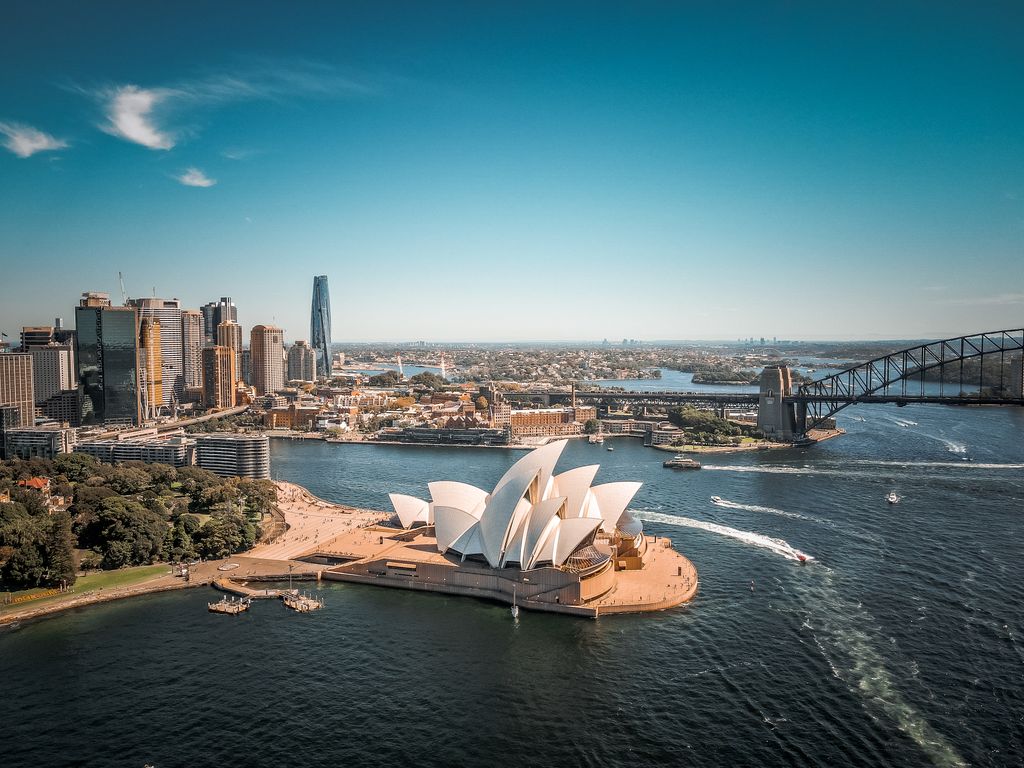
There’s a moment on the ferry into Circular Quay when the harbour opens up and the Sydney Opera House slides into view. Its sails gleam against the water, with the Harbour Bridge arching behind it like a frame. I’ve seen it countless times, and I’m still struck by its beauty every single time.
Living in Freshwater, on Sydney’s Northern Beaches, I catch the ferry into the city regularly. It’s by far the fastest way to travel, and you miss the traffic entirely. But the real reward is the view. Together with the Bridge, the Opera House frames our harbour like nothing else. There’s no better way to see it than from the water.
From the Choir to the Stalls
My own relationship with the Sydney Opera House began when I was very small, as a performer. The first three times I visited, it was to sing with my school choir. Sadly, my voice didn’t flourish enough to earn a return booking after school. And, I’ve happily sat in the audience ever since.
Mostly, it’s been with my girlfriends, watching the The Australian Ballet Company perform there, or sitting through fashion shows, operas musicals, and once I even attended a wedding under those famous sails. I love any excuse to visit.
When I was Editor-in-Chief of The Australian Women’s Weekly, we were proud sponsors of The Australian Ballet, which meant I was able to attend every performance. Years later, I was a judge of the 2015 Telstra Ballet Dancer Award alongside the company’s artistic director, David McAllister, an incredible talent. The winner, announced here on the opening night of The Sleeping Beauty, was Benedicte Bemet, a young coryphée who took home $20,000 and danced the lead role of Princess Aurora the very next night. She is now a Principal Artist with The Australian Ballet.

The more time I spend there, the more I realise this building has never really been just an opera house. Since Queen Elizabeth II officially opened it on 20 October 1973, it has been a bodybuilding arena, an Olympic start line, a protest banner and a canvas for light. Here are some of the most surprising ways the Sydney Opera House has been used.
A Song Before It Was Finished
The Opera House’s first famous performance came 13 years before it opened. In 1960, American singer and activist Paul Robeson climbed the scaffolding and sang “Ol’ Man River” to the construction workers on site.
The first official production, Prokofiev’s War and Peace, followed on 28 September 1973, weeks before the royal opening. Its Danish architect, Jørn Utzon, had resigned from the project in 1966 and never returned to see his masterpiece completed.
A Danish Homecoming
But the Utzon story didn’t end there. In 1999, the Opera House Trust asked Utzon to help shape the building’s future. Then 80 and living in Majorca, he chose not to travel and asked his son Jan, also an architect, to represent him. Together they drew up the design principles that still guide every change to the building. Jan went on to work on its renewal, including the Utzon Room, the only interior space designed by his father, and a new colonnade on the western side. When the Opera House turned 50 in 2023, Jan and his sister Lin flew in from Denmark to share memories of their father, joined by children, grandchildren and other members of the Utzon family.
There’s a royal thread, too, and it’s a fabulous one. Queen Mary of Denmark was born and raised in Hobart, and met her future husband, now King Frederik X, in Sydney during the 2000 Olympics. I felt that unique connection between Australia and Denmark first-hand when I covered their wedding at Copenhagen Cathedral in May 2004, reporting from inside the church. As Crown Prince and Crown Princess, the couple returned to Sydney in 2013 to celebrate the Opera House’s 40th birthday. A Danish masterpiece on Sydney Harbour, celebrated by an Australian who became Queen of Denmark: you couldn’t script it better.
Arnold’s Final Flex
Of all the stars to take the stage in the Concert Hall, few were as unexpected as Arnold Schwarzenegger. On 4 October 1980, the future Terminator made a comeback to win his seventh and final Mr Olympia title there. Not everyone was convinced. Rivals criticised the result and sections of the audience booed. Still, the Opera House had secured its unlikely place in bodybuilding history.
A Royal Night of Fashion
In 1988, Australia’s Bicentennial year, I was a young reporter with AAP when I found myself at the Opera House for one of its most glamorous nights. Prince Charles and Princess Diana were guests of honour at the Bicentennial Wool Collection, a multimillion-dollar fashion extravaganza staged by the Australian Wool Corporation and the International Wool Secretariat to showcase our famous ultrafine Merino wool.
Nine of the world’s greatest designers created collections for the night: Donna Karan, Kenzo, Missoni, Gianni Versace, Oscar de la Renta, Claude Montana, Sonia Rykiel, Jean Muir and Bruce Oldfield, one of Diana’s favourite designers. For the first time ever, they agreed to share a single runway. Tickets reportedly changed hands for up to US$1,800 on the black market, and the show was beamed around the world. With Diana in the audience and the giants of fashion on the catwalk, it felt like the night Australia stepped onto the international fashion stage.
Fashion has drawn me back since. In April 2015, I was in the audience when Carla Zampatti, the Italian-born designer often called Australia’s first lady of fashion, marked 50 years and her 100th collection with a show in the foyer of the Concert Hall. It recreated a runway show she had staged at the Opera House while the building was still under construction.
An Olympic Start Line
When the Olympic Games came to Sydney in 2000, triathlon made its Olympic debut on the Opera House’s doorstep. Athletes plunged into Farm Cove for the swim leg. The race finished in front of the building, cheered on by more than 120,000 spectators.
The People’s House, Protests and All
The Opera House belongs to everyone, and Sydneysiders aren’t shy about saying so. In March 2003, two protesters climbed the tallest sail and painted “NO WAR” in red across its tip. Their target was the looming Iraq war. They were convicted of malicious damage and ordered to pay more than $150,000.
In 2018, the sails were at the centre of another storm. The NSW Government overruled the Opera House’s chief executive to project the barrier draw for The Everest horse race onto them. More than 300,000 people signed a petition against it. On the night, more than 1,000 protesters shone torches at the sails.
A Canvas of Light
These days, the sails are just as famous after dark. They were first lit for Vivid Sydney in 2009, when Brian Eno projected his 77 Million Paintings across them. The Lighting of the Sails has been a festival highlight ever since.
This year’s commission, Opera Mundi by French artist Yann Nguema, was a breathtaking ode to the natural world. Nguema writes his own software, using algorithms and mathematics to turn the tiny details of living things, from cells to organisms, into monumental moving forms. Set to a score by Romanian composer Mischa Blanos, it lit up the sails every night of Vivid Sydney, from 22 May to 13 June 2026. If you missed it, you can watch an 18-minute recording on the Opera House’s streaming platform.
You don’t have to wait for Vivid to see the sails come alive, though. Since 2017, Badu Gili, meaning “water light” in the Gadigal language, has brought First Nations art to the eastern Bennelong sails. The current six-minute show, Story Keepers, featuring the work of Mervyn Street and Ningiukulu Teevee, runs nightly from sunset until 30 November 2026. It’s free, and best seen from the top of the Monumental Steps.
Hawking’s Hologram and a Very Lost Chicken
Some of the Opera House’s most memorable moments are also its strangest. In 2010, 5,200 people stripped off and posed naked on the forecourt for photographer Spencer Tunick. In 2015, Stephen Hawking appeared on stage as a hologram. And during one performance of Boris Godunov, a live chicken landed on a cellist in the orchestra pit. That’s why a net now hangs over it.
Nelson Mandela stood on its steps in 1990, and Prince played a solo show here in 2016, just months before his death.
The latest surprise came on 19 September 2026. As night fell over the harbour, Batman appeared atop the sails to mark Batman Day, striking his famous pose high above the crowds on the forecourt. It’s one of the most unusual sights the building has ever seen.
The Sydney Opera House by the Numbers
- 1,056,006 roof tiles cover the sails.
- 10,244 pipes make up the Concert Hall’s Grand Organ, believed to be the largest mechanical action organ in the world.
- 1,800+ performances are staged each year.
- 10.9 million+ people visit each year.
- 2007 is the year it was added to UNESCO’s World Heritage List.
- Harbour seawater is used to heat and cool the building.
Still the Place for Life’s Big Moments
For all its headline-grabbing moments, the Opera House remains a place where people come to celebrate. Couples marry in the Utzon Room, the Yallamundi Rooms and the Northern Foyers. The Concert Hall reopened in July 2022 after a major upgrade, the final stage of a renewal program costing almost $300 million. In 2023, the building marked its 50th birthday with more than 340 events.
How to See the Sydney Opera House at Its Best
- Arrive by water: Catch the ferry from Manly and watch the Opera House and Harbour Bridge come into view as you glide into Circular Quay. It takes about 30 minutes, or 18 to 20 minutes on the fast ferry.
- Stay for sunset: Head to the top of the Monumental Steps to catch Badu Gili on the Bennelong sails.
- Book a show: Whether it’s ballet, opera, a musical or a concert, a performance is the best way to experience the interiors. See what’s on at the Opera House’s official website.
- Make a night of it: Pair your visit with a city staycation, like our sustainable stay at Novotel Darling Square.
Whether I’m gliding past on the ferry or taking my seat for the ballet, I’m still struck by it every time. My singing career there may have ended with the school choir, but I’ll take any excuse to go back.
