

We arrived in Spain by train, crossing from France into a new country and a whole new rhythm of travel. Four days in Barcelona, followed by a single night in Madrid before flying home. A short trip, deliberately so, as this time I’m not flying solo. I’m travelling with my sixteen-year-old daughter, Luca, which, for a whole host of reasons, changes the shape of everything. Travelling with a teenager doesn’t need to be tricky; you are close, but it’s not constant. Together, but definitely not tethered, albeit finding a rhythm that works for both definitely becomes part of the journey.
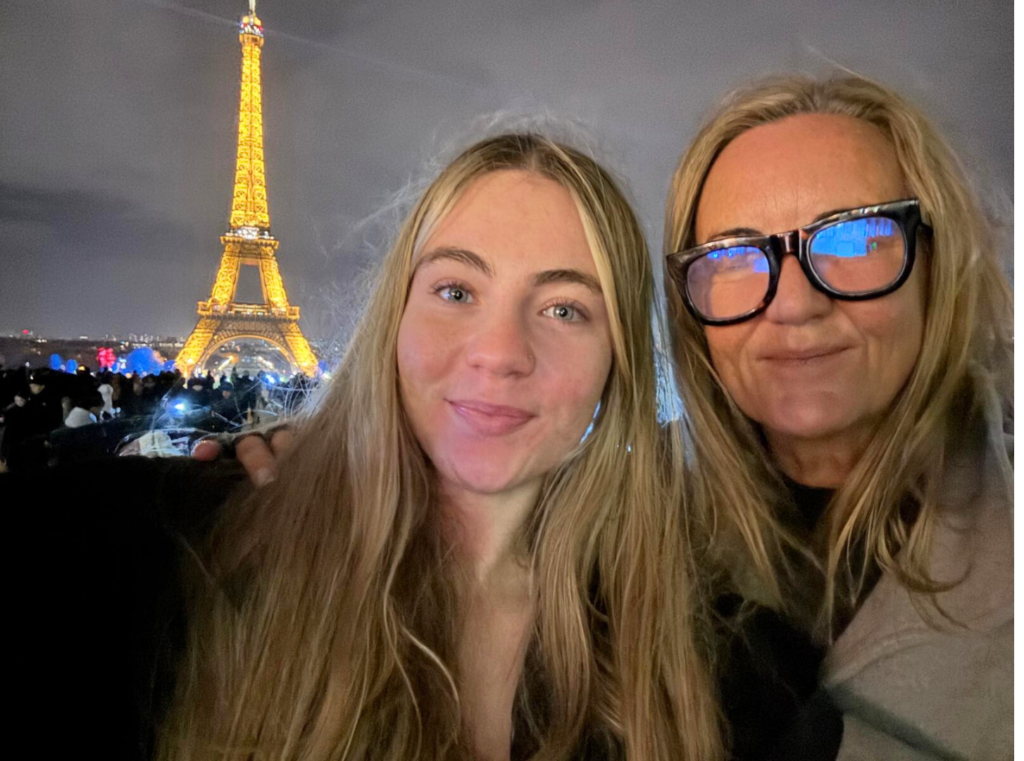
We both agree there is real joy in travelling by train. First-class sounds flash, but for the minor difference in price, it really is a sensible option. Space to stretch, quiet carriages, wide windows to drink in the views, and the ability to move through the journey rather than just endure it.
We were departing Paris Gare de Lyon, heading south into Barcelona Sants, when a minor mishap (with some major panic) landed us in the wrong carriage, one that was breaking away to split the train in two, requiring a rapid changeover 2 hours into our journey. The conductor here was faultless in her support of our predicament. We then settle in for the next 4 hours. The landscape here really does the heavy lifting.
Regional France flattens into farmland; pale winter light rising across fields, small towns, and villages. Vineyards begin to appear as the train moves further south, neat rows breaking the countryside into a semblance of order. Then the terrain tightens and the Pyrenees edge into view, distant at first, until suddenly very dominant.
Crossing into Spain, it feels like everything sharpens. For stretches, the track runs close to the Med, flashes of blue water breaking through scrub and rock. You notice things from a train that you would never see from the air. By the time we arrived in Barcelona, we felt like we’d eased into the city and found a shared rhythm rather than dropped ourselves into it with unmatched energy to burn.

Barcelona turned out to be ideal for travelling with a teenager. We stayed at Hotel Regina, just off Plaça de Catalunya, a hinge point between neighbourhoods that made walking the default and the odd impromptu need for retreat effortless. Our days were loose. We covered a lot of ground and allowed ourselves the freedom to head back independently when energy waned. Gina’s, the hotel bar and lounge, became a reliable decompression space, somewhere to retreat for a cup of tea when a quiet moment alone was the order of the day.
Early December is a lovely time, not too hot and certainly not as cold as the cities we’d left behind. We explored Barcelona Cathedral (Catedral de la Santa Creu i Santa Eulàlia) together, then wandered the Christmas markets as dusk fell, lights strung low across the streets. We paused to help (and fell in love with) a charming older couple from Italy taking their photo the analogue way, a small moment that made us giggle. It was shared time that asks very little. Walking, eating, looking, eating, pausing. Enough togetherness without needing an agenda.
Tapas by the water at Port Vell worked well. Once a working harbour, it was reshaped ahead of the 1992 Olympics into a pedestrian-first waterfront that reconnects Barcelona to the sea. Set between the Gothic Quarter and Barceloneta, it’s lovely and open, perfectly informal, social and unforced. We spent a morning walking from Plaça de Catalunya, across the city to Mirador Del Palau Nacional. From here, Barcelona opens itself up in full, the sweep of Plaça d’Espanya below, the city grid stretching out, and the Palau Nacional behind us. The Palau Nacional houses the Museu Nacional d’Art de Catalunya (MNAC), Barcelona’s primary art museum, home to works ranging from Romanesque frescoes to modern Catalan art. Just behind, the Olympic Stadium on Montjuïc is a monument to reinvention.
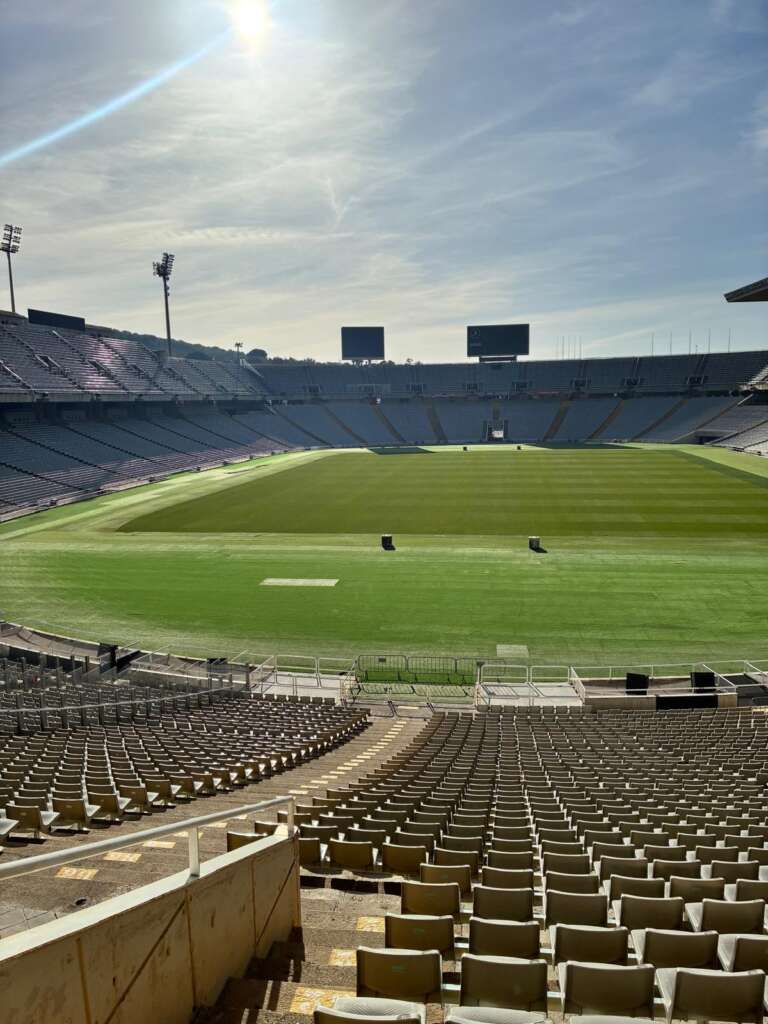
First built in 1929 and reimagined for the 1992 Barcelona Olympics, the stadium has shifted from the symbolic heart of the Games to a solid representation of the city’s long view, now repurposed for everyday civic life, international concerts, community sport, and open access. Adhering to the pull of a quiet spot to rest, we slipped into the empty stands and sat, the scale of it softened by the absence of noise. It was an easy moment to educate an Aussie teen, picturing Andrew Gaze carrying the Australian flag in ‘92, and Kieren Perkins doing the honours at the closing ceremony after his dual gold-medal Olympic debut (that went on to define Australian swimming for a generation). Nothing quite matches the reverence of an empty sporting stadium, this one heavy with the echoes of Olympics past.
Other moments were intentionally separate. I slipped away to Eixample for a quiet wander through Casa Batlló, one of Antoni Gaudí’s most celebrated works on Passeig de Gràcia. Remodelled in the early twentieth century for the Batlló family during Barcelona’s expansion beyond its Roman walls, it remains a defining expression of Catalan Modernism. I followed it with a glass of Cava and a lobster roll at El Nacional, alone and unhurried, while Luca happily claimed the markets and neighbourhood streets with their unique boutiques of El Raval for herself.
I also carved out a slow afternoon at the Moco Museum. Housed in a restored sixteenth-century palace in El Born, it’s historic stone walls framing unashamedly contemporary work. Robbie Williams’ (yes, Take That) Pride and Self-Prejudice was unexpectedly candid, exploring anxiety, ego, addiction, and the performance of confidence without slipping into celebrity excess. I really enjoyed his work. Alongside it, works by Basquiat, Hirst, and Murakami created a sharp mix that was both political and playful. Emerging artists like Gonzalo Borondo sat comfortably among the heavyweights, reflecting Moco’s apparent refusal to separate art history from contemporary expression. The museum was genuinely fun, resisting over-explanation and avoiding spectacle in a city heavy with monuments.
That balance, exploring the city together and apart, felt like a well-earned reward (for both of us) of travelling with someone teetering on the independent cusp of adulthood.
Barcelona’s history sits just beneath every surface. Once a Roman settlement, it later became Spain’s first industrialised city. Life was hard and short, with average life expectancy hovering around twenty-three years. When the Roman walls came down, the city expanded, and opportunity followed. New districts emerged, wealth accumulated, and life expectancy steadily climbed to today’s more palatable eighty-four.
Spain avoided both World Wars, but its own civil war proved devastating. Fought (like most civil wars) along religious and political lines, it left deep scars, particularly in Catalonia. The dictatorship that followed lasted until the (I say recent, Luca says ancient) death of Francisco Franco in the 1970s. When democracy returned, the release was apparently immediate. People danced in the streets. Cava (which is Spain’s really lovely sparkling wine) apparently sold out across the city for weeks, the celebration a collective dance of relief.
Learning from its own history, the 1992 Olympics were treated as a long-term investment rather than a momentary spectacle. Infrastructure, transport, and public space were prioritised. Even the beaches were engineered (who knew?), sand brought from the Sahara, palm trees shipped from the Caribbean. The inside joke is that the only authentic thing about Barcelona’s beaches is the mojito, but it works. The city remains one of Europe’s most considered tourism successes.
I inhaled much of this history on a bus ride out of the city. As Barcelona thinned into open land, the conversation shifted from urban ambition to something older and more elemental. We were heading to Montserrat, where the serrated peaks of the Montserrat Massif rise abruptly from the landscape. On a clear day, you can see across to the snow-capped Pyrenees we’d travelled through, marking the border between Spain and France. The monastery Santa Maria de Montserrat Abbey has sat within this landscape for nearly a thousand years. It is one of the most important spiritual sites in Catalonia and, more broadly, in Spain, a place where history, spirituality and geography converge.
Its position is evidently deliberate. Built high among jagged conglomerate peaks, the monastery reinforces its separation from the ordinary world, physically difficult to reach and therefore spiritually elevated.
At its heart is La Moreneta, the Black Madonna of Montserrat, patron saint of Catalonia and one of Europe’s most revered Marian figures. Pilgrims have travelled here for centuries seeking healing, guidance, and protection.
Montserrat (above) is also a living monastery. Benedictine monks still reside there, following a daily rhythm of prayer, work, and study. The abbey houses one of Europe’s oldest boys’ choirs, L’Escolania de Montserrat, whose performances draw visitors from around the world. Sadly, for us, their voices weren’t echoing through the basilica during our visit.
For me, the monastery worked on several levels at once. It was shaped by faith and history, but also something more rudimentary. Standing there, the landscape did most of the work. The sheer scale strips things back. Your own concerns feel smaller, less urgent. I didn’t go there seeking belief, but I certainly left with perspective. Montserrat, for me, had a way of recalibrating proportion, reminding you where you sit in the order of things.
Luca and I negotiated a thirty-minute window apart, enough time for me to move (way too) swiftly through the museum and take in works by Monet, Picasso, Renoir, and Vayreda. It wasn’t long, but it was enough. Luca skipped the museum entirely, choosing farmers’ markets, cheese tasting and more constant movement of the outdoors. Both experiences felt complete.
Interestingly, Montserrat carries a very cool notoriety. In 2013, the Montserrat Massifwas the site of a now-legendary wingsuit flight by Alexander Polli, who flew through a narrow rock gap just 5.5 metres wide, at more than 150 miles per hour. I remember distinctly watching this online in utter awe. The stunt became known as “threading the needle”. As a former (and still secretly aspiring) adrenaline junkie, standing at the Montserrat Massif, it is easy to understand the pull. The scale distorts judgment. The mountains feel immovable, yet strangely permissive, as if daring you to test the boundaries and limits of your own bravery.
From there, the day continued naturally to Oller del Mas. Set among vineyards and anchored by a medieval tower, it was the counterpoint to both Barcelona’s intensity and Montserrat’s spiritual gravity. Oller Del Mas is a working estate and one of the oldest family-held properties in Catalonia, with a history spanning more than 26 generations and 1,000 years. Wine tastings are unhurried and explanatory, focused on history, place and process rather than performance. The wines lean toward organic and low-intervention practices, which suited the setting and the mood.
Travelling with a teenager worked better than I expected. It offered an introduction to wine culture without excess, to agriculture without overthinking, and to history without spectacle. There was time to walk and explore, to sit (with the most divine kitten) and look outward across the vines and to return at our own pace. The experience shifted nicely away from consumption toward a sense of contentment. The day was a highlight for us both.
Madrid was one night only. Just enough time to register the shift, an afternoon shopping for Luca, followed by an early morning walk through the Real Jardín Botánico before the long-haul home.
Travelling with a teenager feels a little like threading the needle. Moving through narrow space without touching the sides. Close enough to stay connected, far enough to allow some freedom and momentum. Shared meals and separate afternoons. Spain held that balance well. Between the history (me), the shopping (her), the landscape and the architecture (both), there were small, personal victories. Art exploration alone, laughter together over tapas by the water and the shared joy of Oller Del Mas. The quiet satisfaction of getting the distance just right.